
Présentez votre vente aux enchères à des collectionneurs du monde entier !
Soyez référencé dès maintenantEn vous abonnant, vous acceptez la politique de confidentialité. Désabonnez-vous à tout moment.
Barnebys HQ
Brahegatan 10
BOX 5038
114 37 Stockholm
Toutes les enchères / Art Ancien / YOSHITOSHI

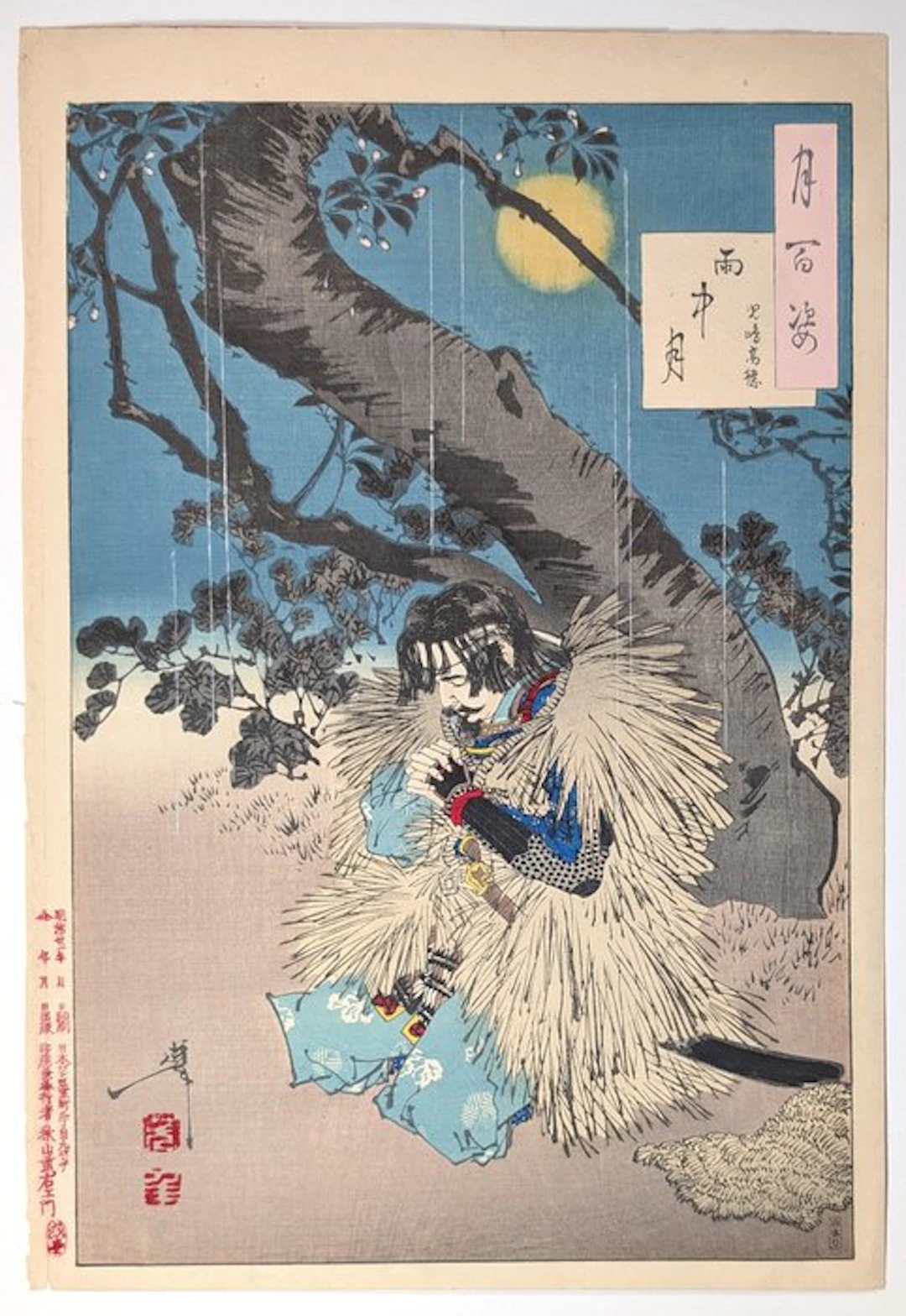
** A SAMURAI'S VIGIL FOR HIS EXILED EMPEROR. RAIN, CHERRY BUDS AND A HIDDEN MOON ** TSUKIOKA YOSHITOSHI (1839–1892) Title: 月百姿 雨中月 児嶋高徳 (Uchū no tsuki – Kojima Takanori), Rainy Moon: Kojima Takanori Series: Tsuki Hyakushi (月百姿) — One Hundred Aspects of the Moon; Stevenson no. 44 Date: Meiji 19 (1886) — red date cartouche 御届明治十九年六月五日 printed in the left margin Publisher: Akiyama Buemon (秋山武右衛門) Format: Ōban tate-e — approx. 36 × 24 cm Technique: Woodblock print (mokuhanga), polychrome (nishiki-e) Condition A stunning impression, with excellent colour throughout. The sheet carries an album backing. The publication block is well perserved: date cartouche, guild seals, the artist's own address seal, and the Akiyama Buemon / Kokkeidō. The Scene In 1331 Emperor Go-Daigo tried to take power back from the Hōjō regents who ruled Japan in the emperor's name. He failed, was captured, and was sent into exile. Kojima Takanori, a young warrior from Bizen province and one of the emperor's most loyal supporters, gathered a small band to rescue him on the road. He picked the wrong route and missed the escort entirely. Determined to reach the emperor anyway, he disguised himself as a peasant in a straw rain cape, slipped into the garden of the inn where Go-Daigo was being held for the night, and stripped a patch of bark from a cherry tree. On the bare wood he wrote a ten-character Chinese verse: Heaven, do not abandon Goujian; the age will not lack a Fan Li. It referred to an ancient Chinese king who lost his throne and was restored by a loyal minister. The guards could not read it. The emperor could. The next morning he saw the message and understood that he was not alone. Yoshitoshi does not show the writing itself. He shows the moment before or after it: Takanori kneeling alone beneath the budding cherry in the spring rain, praying for the emperor he could not reach, while the moon glows faintly through the clouds. The story comes from the Taiheiki, the fourteenth-century war chronicle, and by Yoshitoshi's time it was one of the best-known examples of loyalty in Japanese history. In Meiji Japan, with the emperor restored to real power, loyalists of Go-Daigo's cause were held up as national models, and Yoshitoshi's audience would have read this quiet design as a portrait of devotion. The Series — Yoshitoshi's Late Masterpiece Tsuki Hyakushi (One Hundred Aspects of the Moon), published by Akiyama Buemon between 1885 and 1892, is universally regarded as the crowning achievement of Yoshitoshi's career and one of the last great monuments of the ukiyo-e tradition. Across one hundred designs drawn from history, legend, literature, and — as here — the living festival culture of Edo, the moon serves as the unifying thread. This sheet, published in June 1886 during the strong early run of the series, preserves the full publication block in the margin: the red date cartouche and the Akiyama Buemon address. Yoshitoshi trained under Utagawa Kuniyoshi and is widely regarded as the last great master of ukiyo-e. Impressions of this design are held by the Library of Congress, the National Museum of Asian Art (Smithsonian), the Art Gallery of New South Wales, and other major collections.
Estimation:€700
Vers la vente aux enchèresVoir tous les objets deCatawikiouArt Ancien
Estimation:
€700
Présentez votre vente aux enchères à des collectionneurs du monde entier !
Soyez référencé dès maintenant
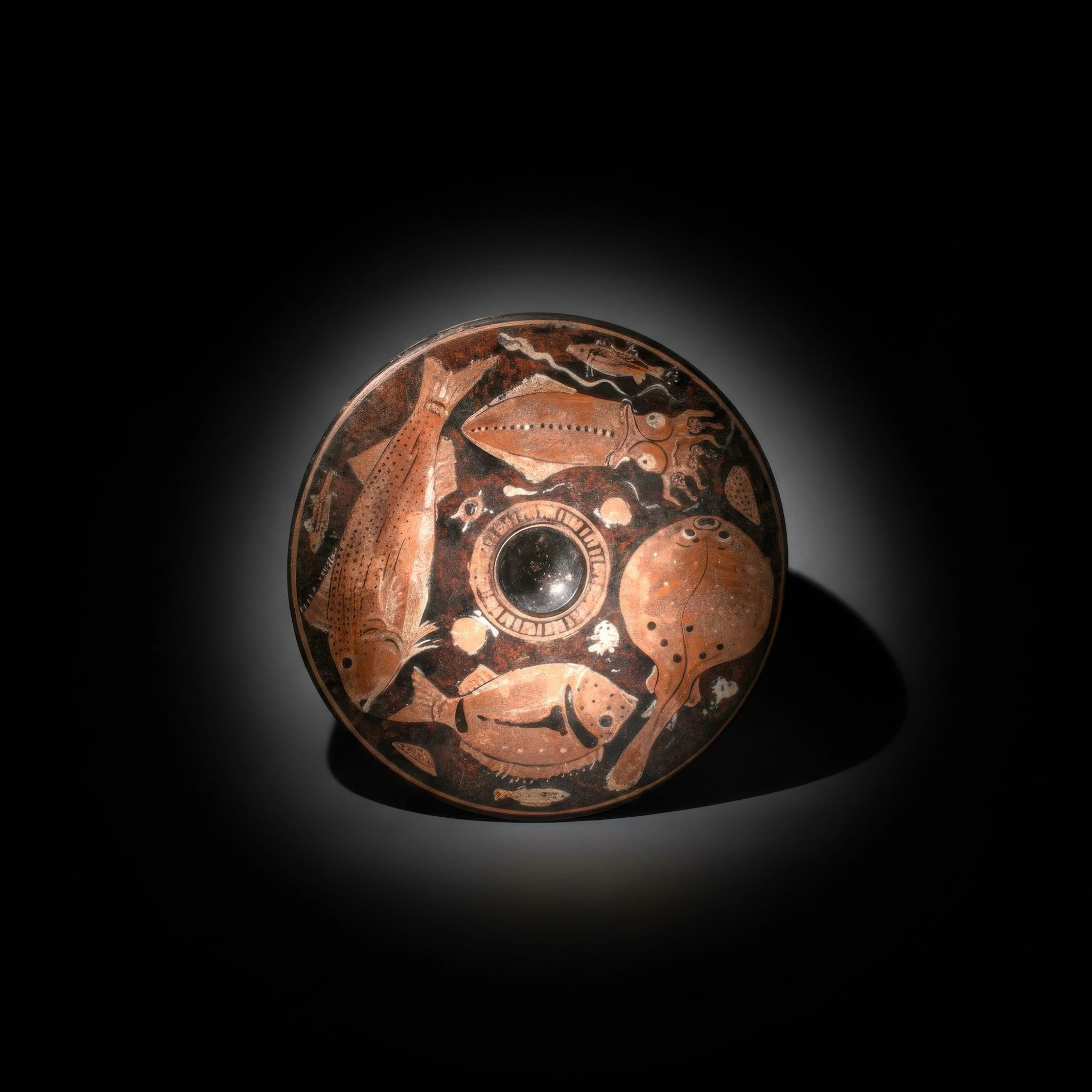
VERY RARE APULIAN RED-FIGURE FISH PLATE WITH 15 SEA CREATURES
06/21/2026

€23,187.64
Est. : €11,540.27