


NOV 7 | 5:00 PM

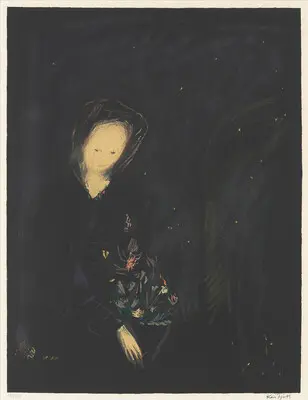
Toutes les enchères / Autres / Siro Penagini (1885-1952) - Donna e bambino


Biography Siro Penagini was born in Milan on December 1, 1885. After an internship at various boarding schools, where he received a notable humanistic education, at eighteen he earned a diploma as a surveyor, but his artistic inclinations led him in 1905 to enroll at the Brera Academy, where he met Aldo Carpi, with whom he remained friends for life. Penagini, of an independent character, feeling uncomfortable with one of the professors, Mentessi, between late 1906 and early 1907 decided to leave Brera and attend the Royal Academy in Munich, where he had the opportunity to come into contact with the new European trends. In 1910 he returned to Italy, health compromised, and until 1913 he stayed in Milan and in Caravate (VA). In 1914, on medical advice, he moved to Terracina, maintaining relations with the Roman artistic milieu, in particular with the artists Spadini, Oppo, Carena, Socrate, Ferrazzi, Selva, and Zanelli. From Terracina he moved to the Sorrentine Peninsula, mainly Positano, where he met Maksim Gorky and became a friend of his. In 1918 Penagini married Rosalinda Steffenini. In 1920 he returned to Milan where he took a studio with Gian Emilio Malerba and in the same year participated in the first Venice Biennale, where he remained present until 1948 (with a solo show in 1938). In that same year, with proceeds from the sale of many of his works to critic and collector Gustavo Botta, he left for Sardinia, where he stayed in Sinnai, Aritzo, Atzara, and Desulo, painting both the landscapes and the people in their archaic costumes. In December 1922 he held his first solo exhibition at Bottega della Poesia in Milan on Via Montenapoleone. In 1923 he retired to Solcio on Lake Maggiore where he restored and enlarged a rustic house, creating a large studio; he spent a few hours reading Russian novelists and studying past artists, especially Giotto, Masaccio, Carpaccio, Raphael, Rembrandt, Vermeer, Goya, and Daumier. He rarely traveled to the town, and in Milan he only went down for exhibitions, such as in 1924 when he was named an honorary member of the Brera Academy, and in 1926 when he participated in the First 20th-Century Exhibition at the Permanente Palace. In 1939 he took part in the second 20th-Century show. In 1934 he won the gold medal at the International Exhibition in Budapest, and in 1936 he received the prize of the Royal Academy of Rome. In 1937, at the request of Architect Piacentini, he frescoed at the Milan Palace of Justice a painting of “Moses dictating the laws”; while in 1939, for E42 (EUR) in Rome, he received the commission for two mosaics, of which he only executed the sketches because the war forced the project’s suspension. The war period was extremely painful for Penagini: for a year he heard nothing of his eldest son who had gone to the front; his friend Aldo Carpi and art critic Raffaello Giolli were deported to the same camp, from which the latter did not return, while at the old jetty in Solcio, near his home, ten partisans were shot by the Germans. From these circumstances he never recovered, and his work diminished until it ceased altogether. He spent his days in silence, reading and meditating. He died in Solcio on December 8, 1952 at the age of sixty-seven."}
Estimation:€175
Vers la vente aux enchèresEstimation:
€175


NOV 7 | 5:00 PM


NOV 12 | 10:00 AM

NOV 8 | 1:00 PM
Présentez votre vente aux enchères à des collectionneurs du monde entier !
Soyez référencé dès maintenantEn vous abonnant, vous acceptez la politique de confidentialité. Désabonnez-vous à tout moment.
Barnebys HQ
Brahegatan 10
BOX 5038
114 37 Stockholm
