



Toutes les enchères / Autres / Pietro Scoppetta (1863-1920) - Due donne orientali

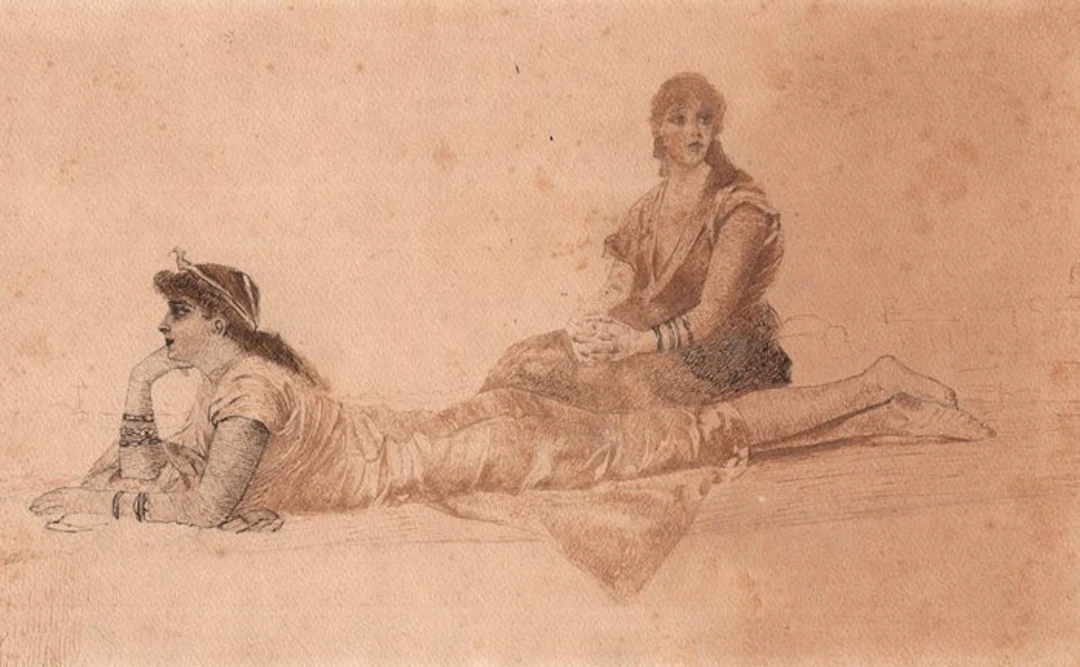
This work is a drawing titled "Two Oriental Women," created by the Italian painter and illustrator Pietro Scoppetta. The piece, dating from the turn of the 19th to the 20th century, is executed in Chinese ink and bistre ink on paper (or finished in monochrome watercolor) and bears the artist’s signature visible in the lower left corner. Pietro Scoppetta (Amalfi, 1863 - Naples, 1920): Two Oriental Women Two Oriental Women is a monochrome watercolor made by Pietro Scoppetta in the 19th–20th century. Scoppetta’s work uses a refined mix of traditional graphic techniques on paper, typical of late 19th-century painters and illustrators, to create effects of light, depth, and softness. The main techniques employed in the drawing are three: 1. Chinese ink • What it is: A very highly pigmented, permanent, and opaque black ink, historically derived from pine soot and animal glues. • How it is used here: Scoppetta uses it with a very fine nib (or a fine-tipped brush) to outline the principal contours, facial details, eye profiles, and the shapes of the hair. It provides structure and geometric precision to the figures. 2. Bistre ink (or sepia) • What it is: Bistre is a brown pigment originally obtained from the soot of burned wood (often oak or beech), giving a warm, yellowish-brown tone. It is often alternated with or combined with sepia ink. • How it is used here: It is employed for shading and mid-tones. The artist applies it to create the shading of the clothing and the carpet on which the women lie. This warm tint blends perfectly with the natural color of aged paper, softening contrasts and imparting a hazy, exotic atmosphere. 3. Monochrome watercolor and wash • What it is: The wash technique involves diluting the ink or pigment with a great deal of water to lay down semi-transparent veils. • How it is used here: Scoppetta does not use color to fill the shapes; instead, he plays with variations in intensity of a single tone (monochrome). By diluting the bistre, he creates chiaroscuro on the bodies and in the background. Volumes are not defined by harsh lines but by soft transitions of light and shadow that mimic painting effects. The support: Rough-textured paper Choosing paper with a light grain or granularity (visible in the background texture) helps retain pigment unevenly. This device enhances the “powdery” and vibrant effect of the drawing, perfect for evoking the hot air and reflected light typical of Orientalist settings.
Estimation:€350
Vers la vente aux enchèresEstimation:
€350
Présentez votre vente aux enchères à des collectionneurs du monde entier !
Soyez référencé dès maintenantEn vous abonnant, vous acceptez la politique de confidentialité. Désabonnez-vous à tout moment.
Barnebys HQ
Brahegatan 10
BOX 5038
114 37 Stockholm
