





Toutes les enchères / Livres, Cartographie & Manuscrits / Philippus Verheyen - Corporis Humani Anatomiae - 1734

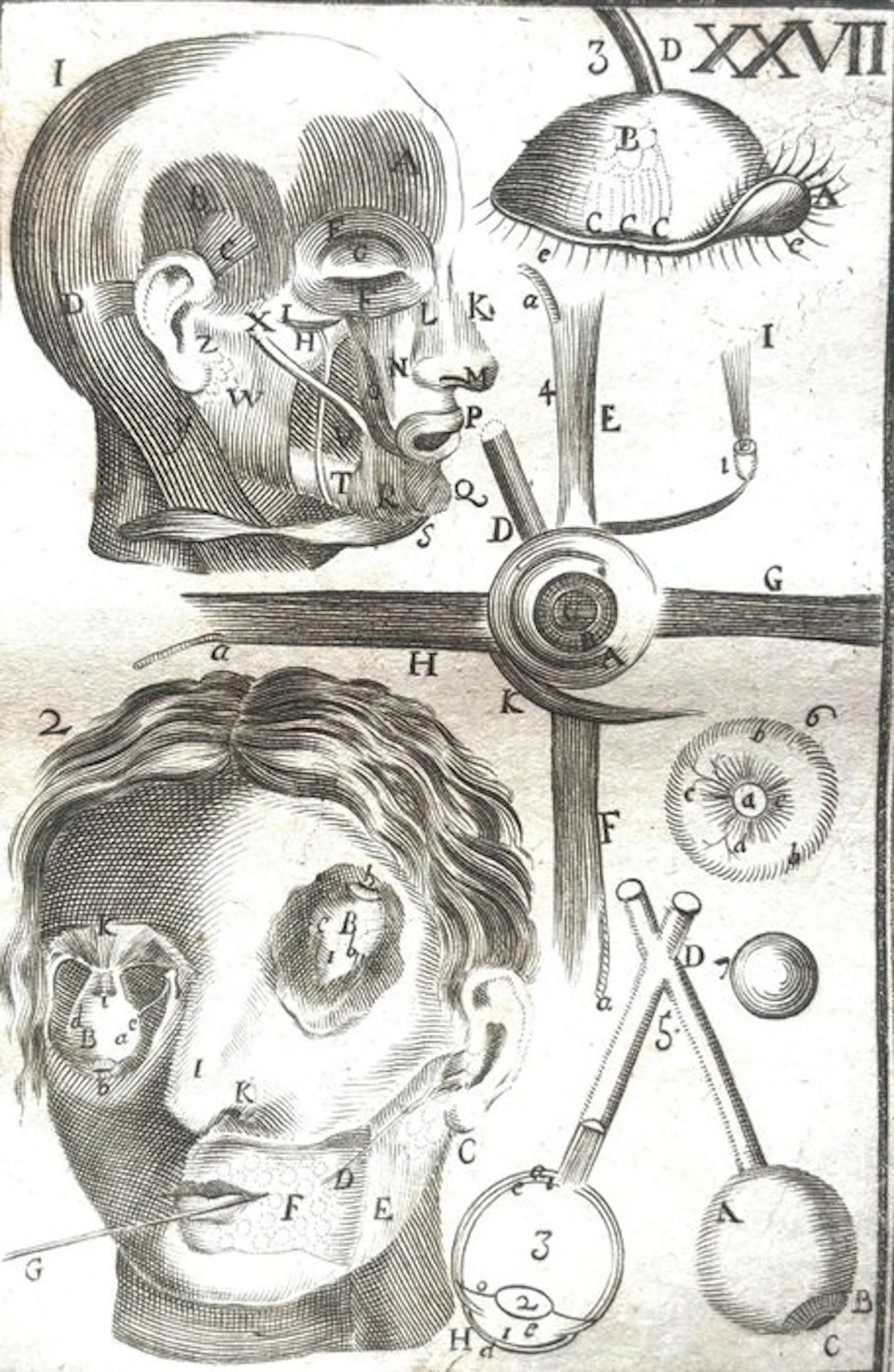
The work we see in the photograph is the Corporis humani anatomiae liber primus, i.e. the “First book of the anatomy of the human body,” written in Latin by Philippe Verheyen. The title page specifies that the author was a professor of anatomy and surgery at the University of Leuven. The copy belongs to the Napoli edition of 1734, with the title printed in red and black. The page also features an important engraving with Verheyen’s portrait, an element that helps transform the book into more than a scientific instrument: a testament to the academic culture of the time. The 1734 edition comprises two volumes and numerous copper-engraved anatomical plates intended to visually represent the structures of the human body. Collation and condition 2 volumes in quarto Vol. I: [16] + 403 + [1] pp., [40] plates Vol. II: XVI + 348 pp., [6] plates Excellent preservation state with minor foxing and a slightly damaged spine to be repaired as shown in the photo. The author: Philippe Verheyen Philippe Verheyen (1648–1710) was a Flemish physician, surgeon, and anatomist. He was born in Verrebroek, in present-day Belgium, and trained mainly at Leuven, where he later became professor of anatomy and surgery. His personal story is particularly significant. Before dedicating himself to medicine, he pursued philosophical and theological studies with the intention of entering the clergy. A severe leg disease caused gangrene and necessitated amputation. This episode played a decisive role in his life and contributed to his shift toward medical studies. Verheyen thus devoted himself to the direct study of anatomy. In 1693 he first published Anatomiae corporis humani, a work that would be expanded and reprinted in numerous editions. His work enjoyed considerable success among anatomists of subsequent generations. A remarkable testament is connected to Albrecht von Haller, one of the great figures of eighteenth-century physiology, who paid close attention to Verheyen’s anatomical studies. The printer and the Neapolitan edition An interesting aspect is that the frontispiece in the photograph bears “Neapoli, MDCCXXXIV,” i.e. Naples, 1734, and specifies Publica Authoritate. In bibliographic catalogs the edition is linked to Bernardino Gessari; the bibliographic entry for the copy held at Sapienza indeed identifies Gessari among the collaborators of the 1734 edition. Nevertheless, it is important to distinguish this Neapolitan edition from the first editions of the work. The first publication of the treatise dates back to 1693, in Leuven, at Aegidius (Gilles) Denique. The seventeenth- and eighteenth-century printing before us is therefore a reissue, produced when Verheyen had been dead for more than twenty years. This shows how enduring his work was in the European medical landscape. The content of the work The book is a true treatise on human anatomy. Verheyen aims to describe the body through a systematic method, bringing together the knowledge of earlier anatomists and the most recent observations. The very title is significant: the author declares his intention to present the discoveries of ancient and modern anatomists through a new and easily understandable method, accompanied by engraved plates. The photograph actually shows one of the book’s most important features: the fusion of text and image. The portrait of the author and the anatomical plates do not merely serve decorative purposes; they belong to the new scientific culture of the time, in which image becomes a fundamental tool for observing, describing, and transmitting knowledge. The work covers many aspects of anatomy: muscles, blood vessels, nerves, brain, heart, abdominal organs, skin, and the reproductive system are among the topics studied. The index of the 1734 edition indeed shows a very broad and detailed structure. The historical significance of the work To truly understand the importance of this book, one must place it within the great transformation of European medicine that began centuries earlier. A fundamental link is with Andreas Vesalius, author in 1543 of the famous De humani corporis fabrica. Vesalius had revolutionized anatomy by challenging many of the knowledge inherited from antiquity and giving great importance to dissection and direct observation of the human body. Verheyen belongs to a later phase of this same revolution. He does not start from scratch: he collects and organizes a very mature anatomical tradition, but continues to regard the observation of the body and its graphical representation as essential tools. In this sense, the book testifies to the shift from medicine founded mainly on the authority of ancient texts toward a medicine increasingly based on observation, comparison, experience, and verification. Another important connection is with William Harvey, who in the seventeenth century demonstrated the circulation of blood. New knowledge about circulation, vessels, and organ structure was profoundly changing how the human body was conceived. Anatomy was no longer merely the description of static parts: it became increasingly linked to understanding the functions of the organism. Even Verheyen’s personal story takes on particular meaning in this context. The fact that a man who had lost a leg became a leading figure in anatomical study strengthens the relationship between personal experience, the body, and scientific knowledge. A book between science, art, and history The photograph also allows appreciation of the manuscript’s material value. The ancient paper, the engraving, the typeface, the two-color printing, and especially the parchment binding are all elements that attest to the book culture of Europe between the sixteenth and eighteenth centuries. Catalogs describe copies of the 1734 edition bound in contemporary leather and with numerous copper-engraved plates. Thus the book becomes more than a simple medical text: it is an object where science, the art of engraving, the history of printing, and the history of medicine converge. The fact that the text is in Latin is also important. In the eighteenth century Latin remained one of the main international languages of European scientific culture. A doctor trained in Leuven, Naples, Paris, or any other great university could recognize and study Verheyen’s work regardless of his own national language. Conclusion In conclusion, this volume represents an extraordinary testimony to the birth of modern medicine. Through the work of Philippe Verheyen we can see how, between the seventeenth and eighteenth centuries, the study of the human body was becoming increasingly precise, systematic, and grounded in observation. Its value is not only scientific. The photograph shows an object that has lasted almost three centuries of history: from the European medical culture of Vesalius, Harvey, and the early great modern anatomists, to the later generations of physicians who would contribute to physiology and the scientific medicine of the nineteenth century. For this reason, Corporis humani anatomiae can be considered simultaneously a medical book, a document of the scientific revolution, and a precious historic artifact. Its importance lies precisely in telling, through text, images, and matter, the moment when the human body began to be studied more and more as an object to be observed directly, understood scientifically, and represented with precision. Shipping express within only 24 working hours across Europe, 48 hours for non-EU countries
Estimation:€300
Vers la vente aux enchèresVoir tous les objets deCatawikiouLivres, Cartographie & Manuscrits
Estimation:
€300


VYKORTSSAMLING - SVENSKA KUNGLIGHETER. GUSTAF V, OSCAR II M.FL. I
10/15/2026
€53.86
Est. : €89.46

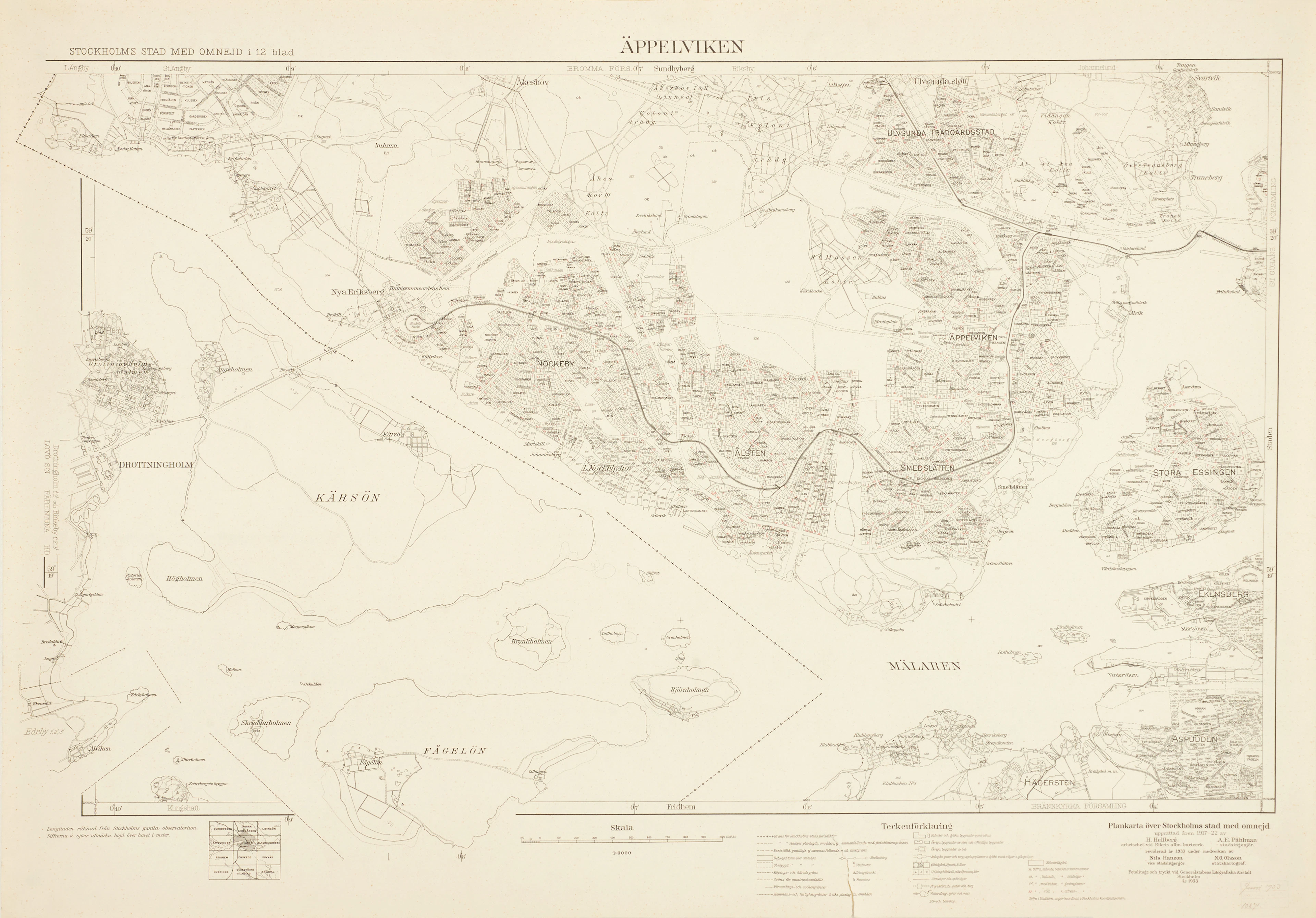
ÄPPELVIKEN, Plankarta över Stockholms Stad med omnejd, 1933, fotolitogr.
10/15/2026
€98.75
Est. : €89.46




OCT 23 | 8:00 AM
Présentez votre vente aux enchères à des collectionneurs du monde entier !
Soyez référencé dès maintenantEn vous abonnant, vous acceptez la politique de confidentialité. Désabonnez-vous à tout moment.
Barnebys HQ
Brahegatan 10
BOX 5038
114 37 Stockholm
