



Toutes les enchères / Autres / Nicolas Poussin (1594-1665), Follower of - La morte di Lucrezia

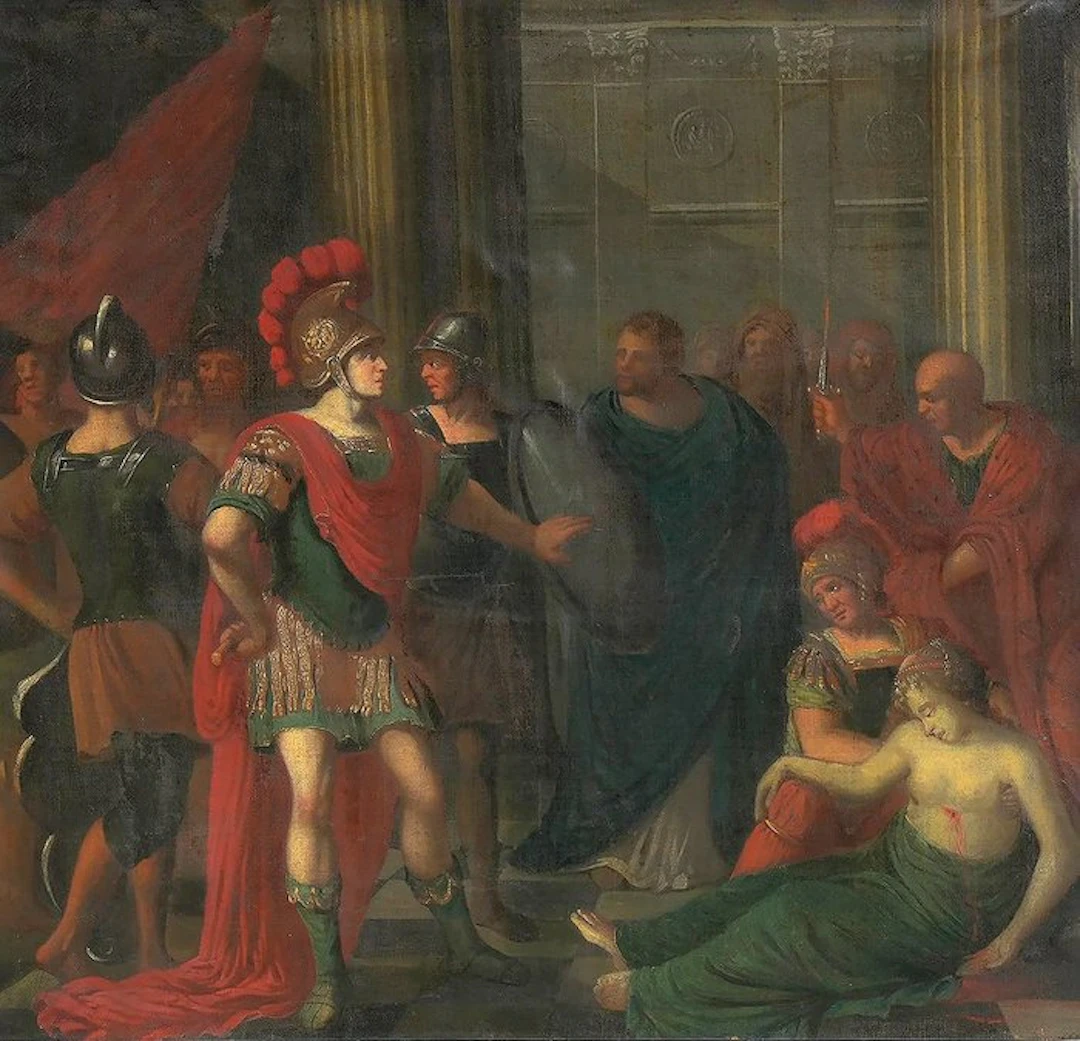
Follower of NICOLAS POUSSIN (Les Andelys, 1594 – Rome, 1665) Lucrezia's Death Oil on canvas, 81 x 84 cm NOTE: Publication catalog of Intermidiart collection works (pdf). Unsigned work. Certificate of Guarantee and Legitimate Provenance. Work without frame: The canvas illustrates the culminating episode of the transition of ancient Rome from monarchy to Republic: the suicide of the Roman heroine Lucrezia, following the affront suffered from Sextus Tarquin. The main characters are arranged horizontally in the foreground, in a compositional setup that recalls ancient bas-reliefs, particularly suited to Nicolas Poussin’s classicist poetics. In the background, a strict monumental architecture, punctuated by pilasters and fluted columns, emerges from the gloom, giving the scene a solemn and theatrical character. Lucrezia’s lifeless body lies on the ground, wrapped in a dark green tunic that intensifies the mortal pallor of the flesh. On her chest is clearly visible the wound caused by the weapon with which she took her own life. An ancillary figure, or more likely a nursemaid, supports her, surrendering to tears and underscoring the dramatic nature of the episode. The group of Romans reacts to the event with agitation. The figure of Lucius Iunius Brutus stands out—or, according to an alternative interpretation, Lucius Tarquinius Collatinus—depicted in majestic ancient golden armor, with a crested helmet adorned with scarlet plumage and a long red cloak. The figure makes a theatrical and assertive gesture, lifting the left arm toward his companions and the soldiers around him, as if urging them to vow revenge and to rise against the tyranny of the Tarquins. Beside him are armed figures, some bearing a red pennon and swords. The painting shows a clear stylistic and formal dependence on the models of the Roman classicism of the seventeenth century, inaugurated by Nicolas Poussin and subsequently elaborated by his direct and indirect followers. The emphasis placed on the morality of the historical episode, the predominance of red tones in the cloaks, the use of dramatic yet carefully controlled chiaroscuro, and the balance of the figures and anatomies connect the work to the figurative classicist culture destined, between the 17th and 18th centuries, to the aristocratic and educated European elite’s quadrature. Nicolas Poussin was born on June 15, 1594 in Les Andelys, Normandy. After moving to Paris, he trained first in the workshop of the Flemish painter Ferdinand Elle and later with Georges Lallemand. During his Parisian formation he came into contact with the French Mannerist culture, especially the Fontainebleau school, and studied also the Italian Renaissance tradition, looking in particular to Leonardo da Vinci and Raphael. In March 1624, after a stay in Venice, Poussin reached Rome, where he settled and developed the most significant part of his career. Although not adhering to the Caravaggesque current, he deepened the tradition of Venetian painting of the sixteenth century, showing particular admiration for the work of Titian, together with the study of sculpture and ancient art and the great masters of the Renaissance. In 1640 Poussin was recalled to Paris at the invitation of King Louis XIII and commissioned to oversee several important decorative undertakings at court and the Louvre. After about two years, however, he returned to Rome, where he spent the rest of his life. Despite health problems, including a tremor in his hands that in his final years increasingly limited his activity, Poussin continued painting up to the last years of his life. He died in Rome on November 19, 1665. From close observation of the painting’s surface, the work’s state of conservation can be described as broadly modest, with alterations attributable to the usual aging processes of an old painting, presumably dating to the end of the 17th or the beginning of the 18th century. There is widespread yellowing of the superficial protective varnish, a phenomenon that alters the original perception of the color palette, reducing the freshness of the cooler tones and accentuating the brown component of the shadows. This alteration mainly affects the architectural backgrounds and the shaded areas of the garments, causing a slight loss of depth and legibility of the chiaroscuro relationships. A physiological craquelure is also visible across the entire surface, fine and apparently stable, attributable to natural aging processes and to differential tensions between the textile support, preparatory layers, and the paint film. The good legibility of the mid-tones of the flesh and the chromatic and material details, such as Lucrezia’s pallor and the golden highlights of the foreground figure’s armor, could indicate the absence of particularly aggressive cleaning interventions. The preservation of tonal transitions and glazing suggests that the paint film has maintained, at least in part, its original stratification. The canvas frame may have been replaced during a previous lining intervention. The current dimensions of the canvas are 81 × 84 cm. The painting is sold without a frame, although it is beautifully embellished by a wooden frame. PROVENANCE: Private Collection PUBLICATION: - UNPUBLISHED QUADERIA, General Catalog of Paintings from the Intermidiart Gallery collection by Andrea Maggio, 2026 (pdf). In the case of sale outside Italian territory, the buyer must wait for the export paperwork processing times.
Estimation:€2,800
Vers la vente aux enchèresEstimation:
€2,800
Présentez votre vente aux enchères à des collectionneurs du monde entier !
Soyez référencé dès maintenantEn vous abonnant, vous acceptez la politique de confidentialité. Désabonnez-vous à tout moment.
Barnebys HQ
Brahegatan 10
BOX 5038
114 37 Stockholm
