




Toutes les enchères / Arts asiatiques / Mahakala, Lord of the Pavilion. - Copper - China - 20th century

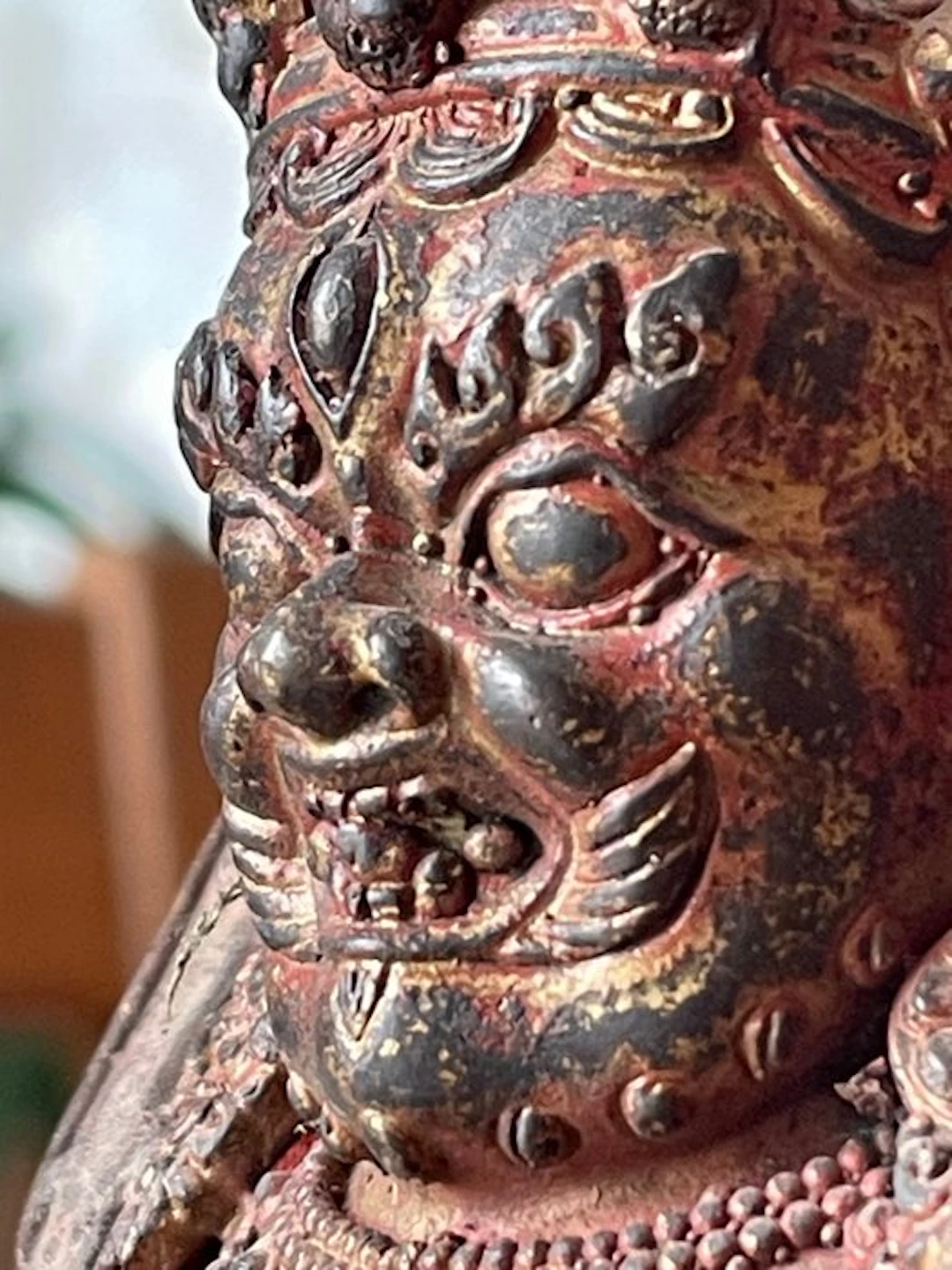
Tantric Buddhist sculpture in gilded bronze and polychrome – China / Tibet. Stylistic origin: Sino-Tibetan tradition, Qing dynasty. Material: Copper alloy, gilding and traces of red and black polychromy. Subject: Protector deity of tantric Buddhism, depicted in an enraged form. Remarkable religious metal sculpture, gilded and polychrome, attributed to the very end of the 18th century, at the transition between the reigns of emperors Qianlong (1735–1796) and Jiaqing (1796–1820). This work belongs to the artistic tradition of Sino-Tibetan esoteric Buddhism, particularly present under the Qing dynasty. The deity is represented in a powerful, protective stance, with an expressive face and wide-open eyes, an open mouth showing fangs, a towering multi-headed crown, and a rich array of ritual jewelry. She holds an elongated attribute in front of her chest and rests on a prone figure, symbolizing domination over negative forces and spiritual ignorance. The whole rests on a finely modeled lotus pedestal, framed by a substantial removable flaming mandorla. It features numerous volutes, symbolic ornaments and, at its summit, a winged figure evoking Garuda, the guardian being of Buddhist tradition. The sculpture retains significant traces of gilding, associated with red and black polychromy on the underlying layers, offering a particularly interesting contrast and highlighting the richness of decorative work. Unlike late 19th-century copies that place touches of red over gilding. The reverse shows a meticulous treatment of clothing, jewelry and coiffure. Under the base is a double vajra engraved, a ritual symbol of stability and spiritual indestructibility. Historical and religious context Under the reign of Qianlong, Tibetan Buddhism enjoyed considerable imperial patronage. Chinese and Tibetan workshops developed a production of religious sculptures combining Himalayan iconographic traditions with Chinese metallurgical and decorative techniques. Alongside the great imperial commissions, there was a production of devotional objects intended for temples, sanctuaries and domestic altars. Templegoing occupied an important place in the religious life of the Chinese population. Believers could make offerings there, fund sacred objects or acquire religious representations to be kept in their homes. These sculptures served as supports for prayer, protection and personal devotion. Some were offered to sanctuaries to accompany the vows of the faithful, while others joined family altars. This work can be linked to this tradition of devotional religious objects, though its initial destination cannot be precisely established. Artistic qualities The sculpture is distinguished by several characteristics: • The expressive power of the face, typical of wrathful protective deities. • The complexity of the crown and ritual ornaments. • The richness of jewels and finely worked garments. • The presence of a substantial intricately worked aureole. • The preservation of traces of old gilding and polychromy. • The double Vajra engraved beneath the base, reinforcing its religious dimension. Condition Ancient condition with a dark patina, gilding wear, alterations of polychromy and oxidation traces in the correct direction of the fabrication layers (black, red then gilded). The mandorla is removable and the transverse attribute is detached, as shown in the photographs. Wear and small deformations are visible on some decorative elements. These features should be considered in assessing the overall condition of the object and its attribution. Conclusion Beautiful sculpture of Sino-Tibetan Buddhist tradition, stylistically attributed to the late 18th century, evidencing the reach of religious art under the Qing dynasty. Its protective iconography, rich ornamentation and traces of polychromy give it artistic and historical interest, particularly for collectors of Chinese and Himalayan Buddhist art.
Estimation:€150
Vers la vente aux enchèresVoir tous les objets deCatawikiouArts asiatiques
Estimation:
€150



OCT 23 | 8:00 AM
Présentez votre vente aux enchères à des collectionneurs du monde entier !
Soyez référencé dès maintenantEn vous abonnant, vous acceptez la politique de confidentialité. Désabonnez-vous à tout moment.
Barnebys HQ
Brahegatan 10
BOX 5038
114 37 Stockholm
