
![ÉGYPTE]](https://bbys.imgix.net/6/cce4633eab8f0508b038cbe46b74887268a284d1d081ec7dafa564b399f8518d.jpg?auto=format&w=3840&q=75)





Présentez votre vente aux enchères à des collectionneurs du monde entier !
Soyez référencé dès maintenantEn vous abonnant, vous acceptez la politique de confidentialité. Désabonnez-vous à tout moment.
Barnebys HQ
Brahegatan 10
BOX 5038
114 37 Stockholm
Toutes les enchères / Livres, Cartographie & Manuscrits / La Feillée - Plain-Chant et Psalmodie - 1835

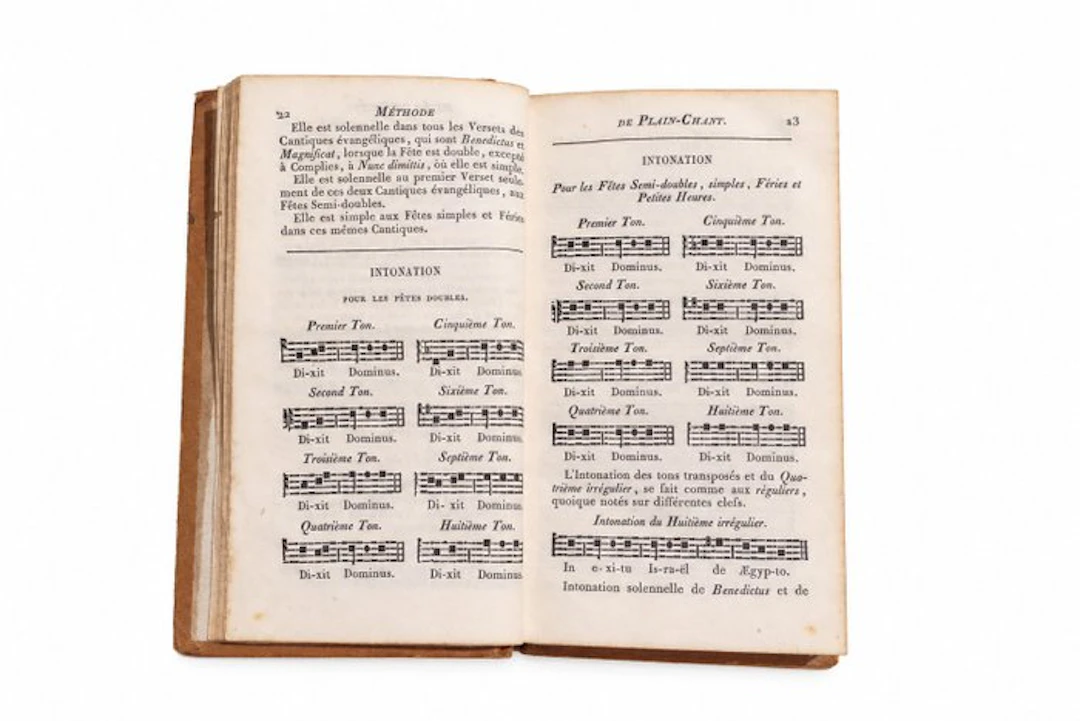
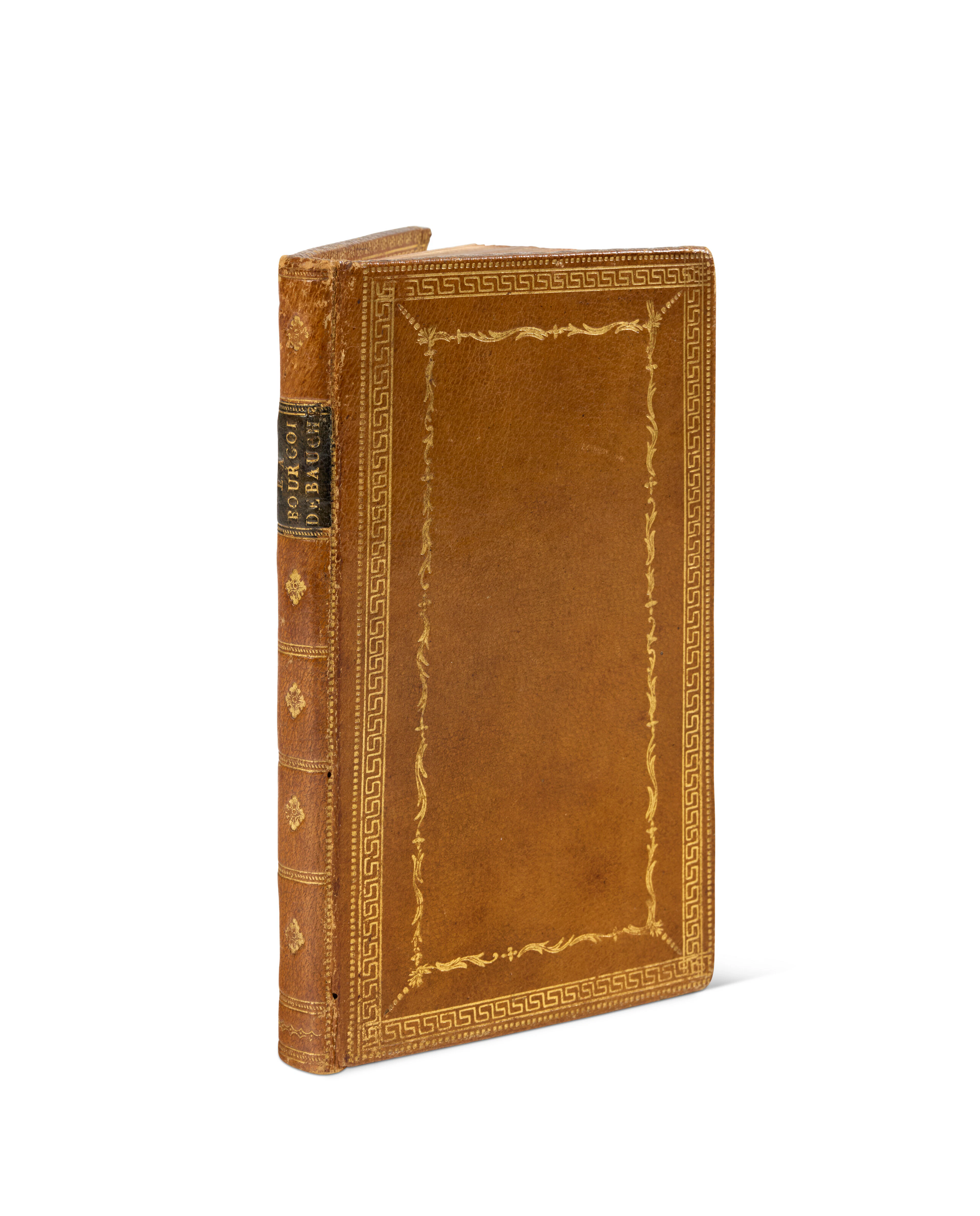
[Please note that the background setting in some images was created using AI to present the books in a pleasant environment. These background elements do not alter or affect the true representation and condition of the books] THE RARE SINGING MANUAL WITH HUNDREDS OF MUSICAL NOTATIONS Rare eighteenth-century edition of the famous method by François de La Feillée dedicated to plain-chant and psalmody according to the Roman and Parisian rites. Published in 1835 between Paris and Avignon, it revisits and expands one of the French ecclesiastical singing manuals most long-lived in the 18th and 19th centuries. The volume contains numerous musical examples printed in the text, masses, intonations, psalms, and plain-chant compositions, both simple and figurated. An interesting testimony of French Catholic musical practice on the eve of the great nineteenth-century movement to restore Gregorian chant. A complete octavo copy of VIII, 544 pages, preserved in full original leather with decorations and gilded spine labels. WHY TO BUY RARE 1835 EDITION – Paris-Avignon edition of 1835 now hard to find on the antique market; current commercial research shows availability mainly of seventeenth-century editions or modern reprints, not this specific impression. MUSIC THROUGHOUT – Hundreds of examples of square and figurated notation accompany the treatment and the numerous liturgical compositions, making the volume particularly interesting for collectors of early music and the history of liturgy. IMPORTANT HISTORY OF CHANT – La Feillée’s Méthode, originally appearing in 1748 and repeatedly reprinted and expanded for almost a century, achieved wide diffusion in the French teaching of ecclesiastical singing. CONTEMPORARY LEATHER BINDING – A specimen in its elegant full nineteenth-century leather, with gilded title and ornaments on the spine and decorated edges, overall very well preserved. MARKET VALUE The relative rarity of this specific 1835 impression, the extensive musical apparatus, the completeness and the preservation of the antique binding justify for this copy a retail valuation in the region of €350 - 550 PHYSICAL DESCRIPTION AND CONDITION Full contemporaneous leather; smooth spine decorated with gilded fillets and ornaments, gilded title “MÉTHODE DE PLAIN-CHANT”; marbled edges. Mild abrasions and small superficial losses to the leather, more evident at the corners and ends of the spine, compatible with age. Frontispiece with woodcut vignette. Text in French with numerous musical notations printed in the text, including examples of intonation, psalmody, masses, hymns, antiphons, litanies, Stabat and other liturgical pieces. Leaves with some foxing. In old books with a multi-century history, some imperfections may be present, not always noted in the description. This listing contains AI Visualizations. Please refer to the original photographs to verify the actual condition of the object. The images are an integral part of the description. Pp. (2); 2nn; 8; 544; (2). FULL TITLE AND AUTHOR Méthode de Plain-Chant et de Psalmodie selon les rites Romain et Parisien. Paris, Méquignon J.or; Avignon, A. Chambeau, 1835. François de La Feillée. CONTEXT AND SIGNIFICANCE Plain-chant constitutes the great monodic tradition of Western liturgical singing. La Feillée’s work began as a practical manual intended for clergy, singers, parishes, and religious communities, and tackles not only note-reading but also tonality, intonation, psalmody, pronunciation, cadences, and practical execution of the sacred repertoire. The peculiarity of this edition is the joint reference to the Roman and Parisian rites, particularly significant in early 19th-century France when local liturgical traditions persisted alongside a gradual return toward Roman uniformity. Even in 1830 only a portion of French dioceses celebrated according to the Roman rite, and in the following decades a wide reform and restoration movement for ecclesiastical singing developed. The numerous pages of music transform the volume from a mere theoretical treatise into a true operational instrument: after the rules come examples, the eight tones’ intonations, masses, and a vast repertoire for execution throughout the liturgical year. BRIEF BIOGRAPHY OF THE AUTHOR François de La Feillée was a French ecclesiastical and theoretical figure in sacred singing, connected with the ecclesiastical musical circles of Chartres and Poitiers. Modern sources place him approximately between 1700 and 1763; beyond the famous Méthode, he worked on liturgical repertoires such as antiphoners, Graduals, masses, and other ecclesiastical singing pieces. His name remains chiefly associated with the Méthode nouvelle pour apprendre parfaitement les règles du plain-chant et de la psalmodie, one of the most successful French manuals of its kind. The clarity of the exposition contributed to its long editorial life, and as late as 1843 François-Joseph Fétis explicitly recalled the success achieved by La Feillée’s method. PRINTING HISTORY AND CIRCULATION The first edition of the Méthode appeared in Poitiers in 1748. A considerably expanded second edition followed in 1754, a third in 1760, and numerous reprints throughout the 18th century. In 1782 the work was revised, corrected, and enlarged by an ecclesiastic identified as a La Feillée’s pupil, an element that explains the wording kept in the frontispiece of the 1835 edition. The work’s vitality continued into the 19th century: Fétis, writing in 1843, notes editions in Avignon in 1810 and 1815, in Lyon in 1812, in Paris in 1823, and in Avignon in 1825, showing that the text was still in use nearly a century after its first appearance. The edition presented here, Paris–Avignon 1835, thus belongs to the late and fully nineteenth-century phase of the work’s fortune. The preliminary note “Avis sur cette nouvelle édition” directly underscores the success of earlier printings and states that the new edition had been revised and expanded. I would not, however, describe as “two copies known” without checking international catalogs; the commercially solid formulation is “RARE 1835 EDITION, CURRENTLY DIFFICULT TO REACH ON THE MARKET.” BIBLIOGRAPHY AND REFERENCES Bibliothèque nationale de France, Catalogue général, authority François de La Feillée. Fétis, François-Joseph, Méthode élémentaire de plain-chant à l’usage des séminaries, des chantres et organistes, Paris, 1843. La Feillée, François de, Méthode nouvelle pour apprendre parfaitement les règles du plain-chant et de la psalmodie, Poitiers, Jean Faulcon, 1748. La Feillée, François de, Méthode nouvelle pour apprendre parfaitement les règles du plain-chant et de la psalmodie, Paris–Poitiers, Hérissant–Faulcon, 1754. La Feillée, François de, Méthode nouvelle pour apprendre parfaitement les règles du plain-chant et de la psalmodie, Poitiers, Jean Faulcon l’aîné, 1760. Centre de Musique Baroque de Versailles, Guide historique et pratique du plain-chant baroque et du faux-bourdons. Bibliothèque nationale de France, Département de la Musique. WorldCat, international catalogs of François de La Feillée’s works. CCFr – Catalogue collectif de France. RISM – Répertoire International des Sources Musicales.
Estimation:€200
Vers la vente aux enchèresVoir tous les objets deCatawikiouLivres, Cartographie & Manuscrits
Estimation:
€200
Présentez votre vente aux enchères à des collectionneurs du monde entier !
Soyez référencé dès maintenant
[SIGOGNE, Charles-Timoléon de Beauxoncles, sieur de (attribué à)
03/24/2026

€16,510
Est. : €10,000