





Présentez votre vente aux enchères à des collectionneurs du monde entier !
Soyez référencé dès maintenantEn vous abonnant, vous acceptez la politique de confidentialité. Désabonnez-vous à tout moment.
Barnebys HQ
Brahegatan 10
BOX 5038
114 37 Stockholm
Toutes les enchères / Monnaies & billets de collection / Henry VI, First Reign (1422-1461), Pinecone-Mascle Issue, Noble, 1431
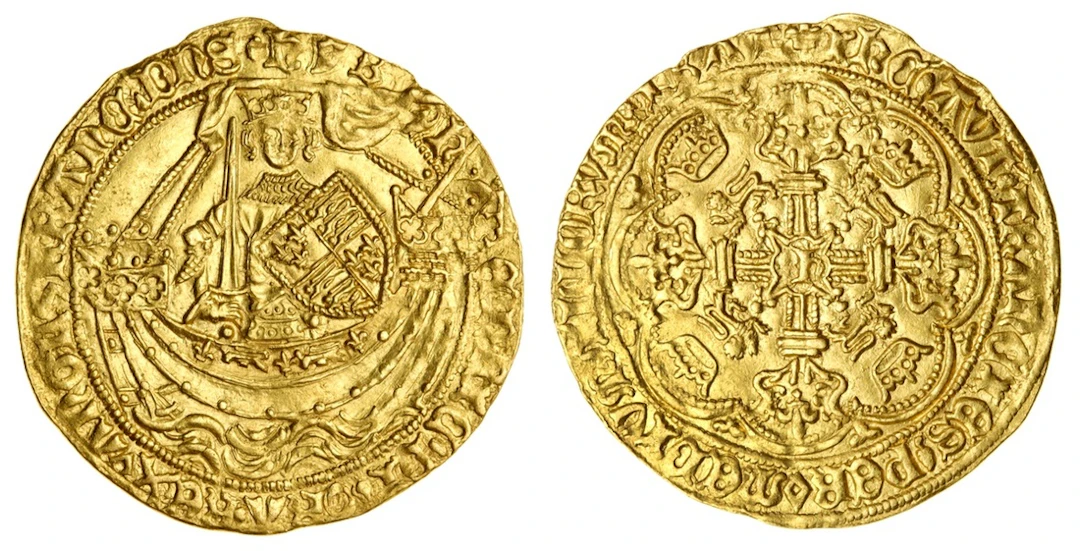
Henry VI, First Reign (1422-1461), Pinecone-Mascle Issue, Noble, 1431 - September 1432, Tower (London), dies by John Orewell for Mintmaster William Rous/Russe, h | EnRIC '. DI '. GRA '. REX AnGL x Z FRAnC . DnS . hyB, pinecone stop 2, King standing in ship, holding sword and shield, ropes 2/1, quatrefoils 3/3, ornaments 1-1-1, rev. (m.m.) IhC '. AVT . TRAnCIES . PER mEDIVm . ILLORVm. IBAT [sic], additional lys in second quarter, 6.90g [106.48grns], 12h (Schneider I, 322; Whitton [1938], p.228-229, nos. 23a/25a; L A Lawrence 37; Lockett 3092; North 1457; S.1824), slight irregularity to upper edge, otherwise beautifully lustrous and superbly choice, much as struck, an historic piece struck in the year of capture of Joan of Arc at the Siege of Compiègne; extremely rare, especially so in this exemplary condition; and with an exceptional pedigree to the largest Medieval coin hoard found in Britain, most of which now resides in the British Museum Provenance Mr Bernard Beeton, Glendining, 17 October 1968, lot 65 - "edge slightly jagged, otherwise extremely fine and rare" - £700.0.0 (via Spink) Fishpool Hoard (Ravenshead, Nottinghamshire), 1966 "On 22 March 1966, the Fishpool Hoard of 1,237 15th Century Gold coins, four rings and four other pieces of jewellery, and two lengths of gold chain was discovered by workmen on a building site near Newstead Abbey (present-day Cambourne Gardens). The hoard was probably buried in haste between Winter 1463 and Summer 1464, probably during a flight south after the Battle of Hexham on 15 May 1464. Only two of the six finders fulfilled the conditions required by the law in relation to Treasure Trove, a Mr Bernard Beeton, and a small boy, Master D. Welham. Mr Beeton found 100 coins, of which 15 have subsequently been purchased by museums, and the remaining 85 returned to him. Master Welham found four coins, which were returned to him and these have subsequently been privately sold." Alongside the wondrous array of 14th and 15th Century Gold Coins recovered were several pieces of jewellery, including a heart-shaped brooch, inscribed: "je suys vostre sans de partier" ("I am yours wholly") Struck in London during the eighteen months bracketed by two of the most consequential events of the Hundred Years' War, this Noble carries the very claim that cost the ill-fated Joan of Arc her life. The obverse legend proclaims Henry VI not only King of England, but also of France. This being the same French crown that Joan of Arc had spent 1429 fighting to secure for the Dauphin, who was crowned Charles VII at Reim that July. Joan was a peasant girl in her late teens who came from Domrémy in North-East France. Having claimed divine visions that apparently instructed her to save France, she managed to talk her way into an audience with the Dauphin Charles at Chinon in early 1429. Given a small force, she went on to lift the English siege of Orléans that May, a victory that turned the tide of a war that England had (up until then) been steadily winning. She proceeded to lead the campaign that brought Charles to Reims for his coronation a few months later, in July. Joan of Arc was captured by Burgundian allies at Compiègne in May 1430 and then sold to the English. She was tried at Rouen, not by a secular court, but by a French ecclesiastical tribunal which was operating under English political control, on charges of heresy which centred on her visions and her wearing of men's clothing. When she was just nineteen years old she was burned at the stake in the Rouen marketplace on 30th May 1431. A quarter of a century later, a posthumous Church retrial annulled her conviction and she was eventually canonised as a saint five centuries later, in 1920. England's response to Reims came at Joan's expense. Her trial and subsequent execution fell at exactly the same time as this gold Noble's minting period. Seven months after her death, on 16th December 1431, a ten-year-old Henry VI was crowned King of France in Notre-Dame in Paris. This was the only such 'counter-coronation' of the whole war, and was the direct answer to Charles VII's anointing at Reims. This rare coin is a rare window into the eighteen-month collision of two rival Coronations and one Execution. It was struck by the same Government, in the name of the same disputed title, that sent Joan of Arc to the stake. Subject to 20% VAT on Buyer’s Premium. For more information please view Terms and Conditions for Buyers.
Estimation:€17,452.42
Vers la vente aux enchèresVoir tous les objets deSpink AuctionsouMonnaies & billets de collection
Estimation:
€17,452.42
Présentez votre vente aux enchères à des collectionneurs du monde entier !
Soyez référencé dès maintenant
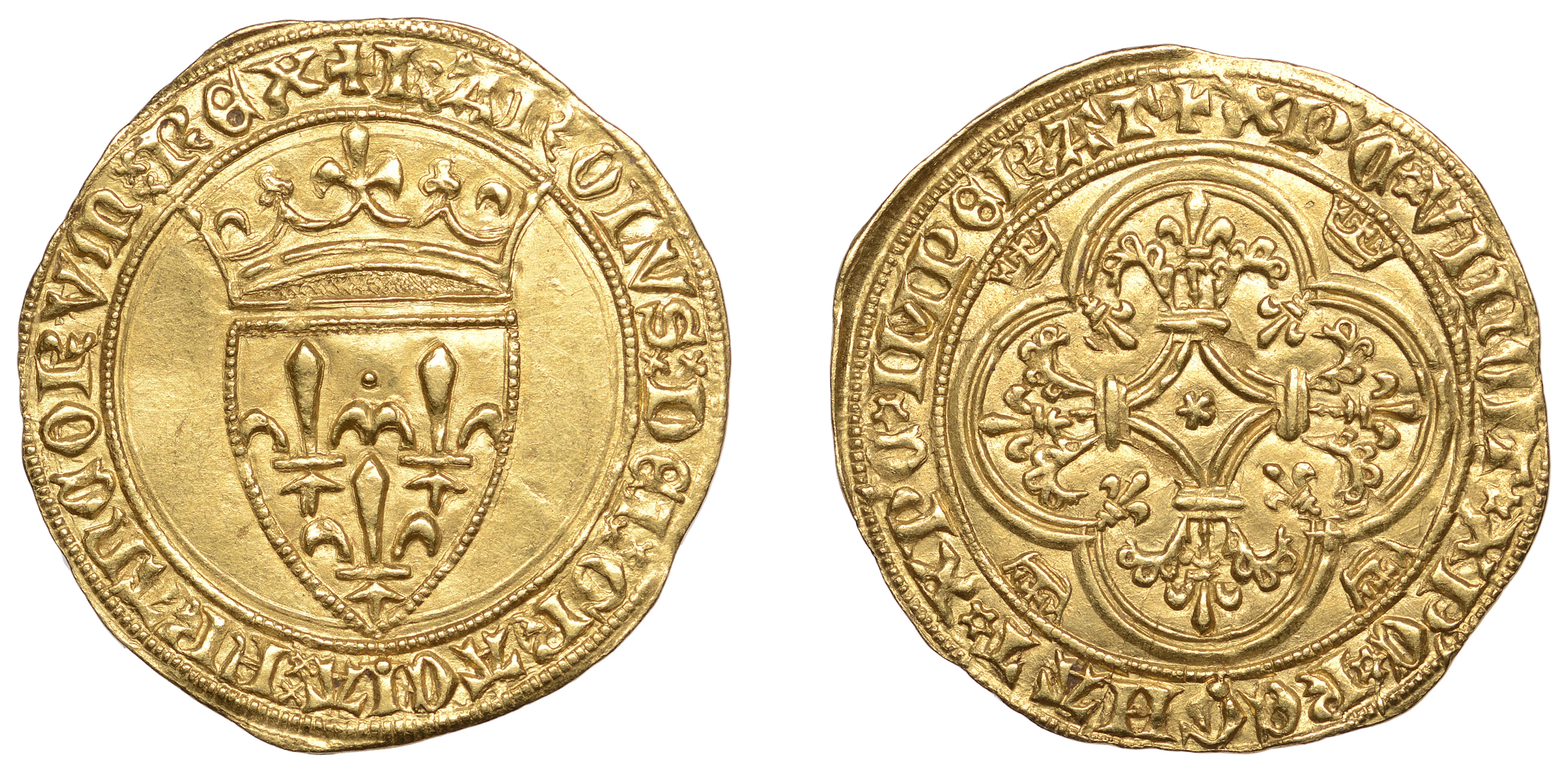
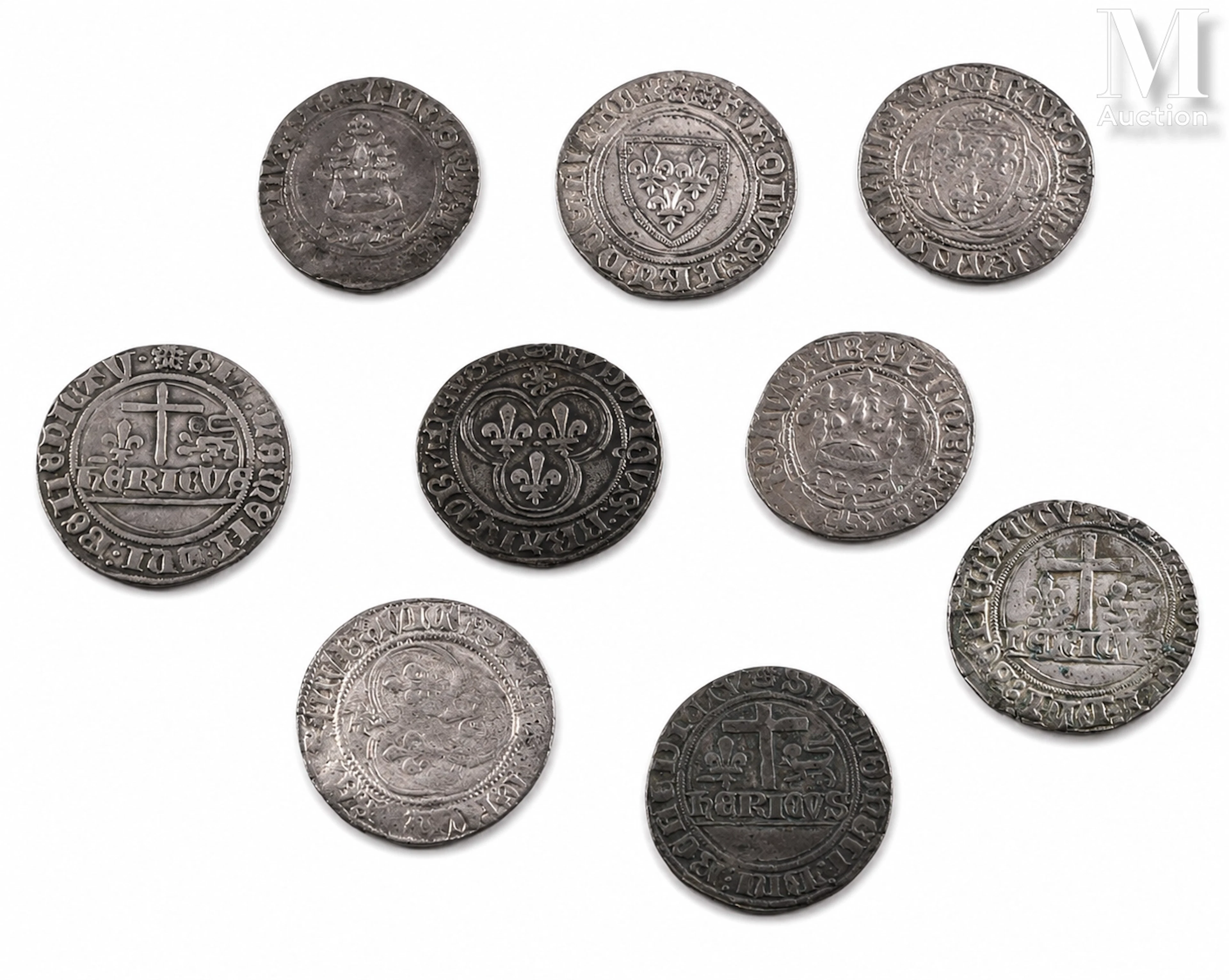
France, Charles VI (1380-1422), Écu d’or à la couronne, third and
09/08/2026

€1,106.18
Est. : €936.2
