



Toutes les enchères / Livres, Cartographie & Manuscrits / Giordano Riccati - Delle corde ovvero fibre elastiche...

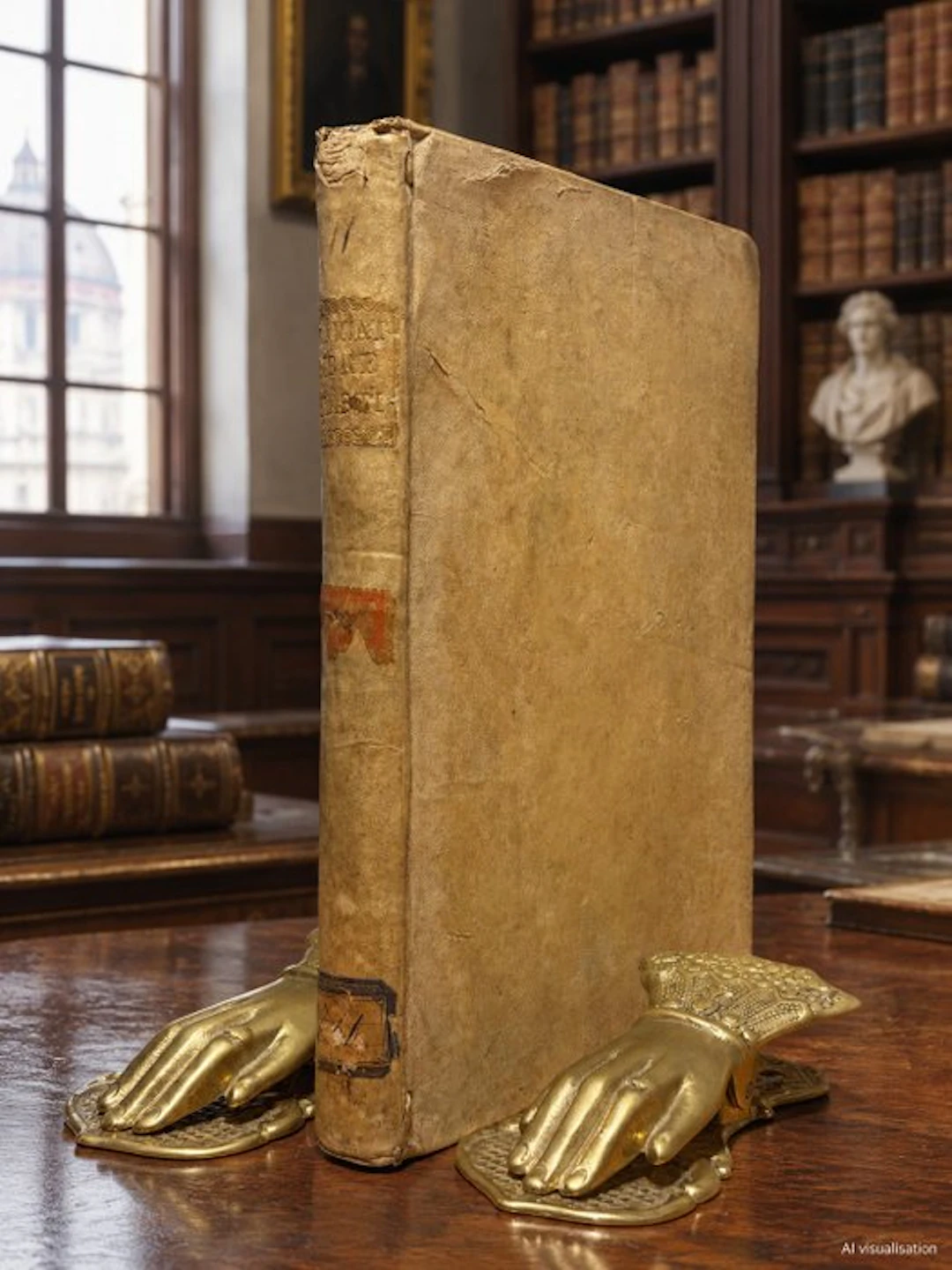
Giordano Riccati — Of Strings or Elastic Fibers. Physico-mathematical Sketches Bologna, Stamperia di San Tommaso d’Aquino, 1767 The copy presented here belongs to the first edition, published in Bologna in 1767, of one of the most significant works of Italian science in the 18th century devoted to the mechanics of strings, vibrations, and acoustics. The volume, in quarto format and of 246 pages, is accompanied by illustrative plates with geometric and physico-mathematical diagrams intended to render visible phenomena that Riccati subjects to rigorous mathematical analysis. The author: Giordano Riccati Giordano Riccati (Castelfranco Veneto, 1709 – Treviso, 1790) belonged to one of the most important scientific families of 18th-century Italy. Son of the mathematician Jacopo Riccati and brother of Vincenzo Riccati, he was educated with the Jesuits in Bologna and earned a law degree in Padua in 1731, while dedicating his intellectual activity mainly to mathematics, physics, theoretical music, and architecture. His figure is particularly interesting because it perfectly embodies the 18th-century tendency to connect different disciplines. For Riccati, mathematics was not a detached abstract science from experience: it could be applied to music, mechanics, acoustics, architecture, and the study of materials. His interest in vibrations also stemmed from music. Reflections on the strings of musical instruments gradually led him toward more general problems concerning elasticity, oscillations, and the propagation of sound. His research on elastic cords began around 1740 and would, after years of development, culminate in the 1767 volume. Riccati also maintained intellectual relations with important figures in Italian musical and scientific culture, including Antonio Vallotti, Giovenale Sacchi, and Giuseppe Tartini. The work and its content The full title, **Delle corde ovvero fibre elastiche. Schediasmi fisico-matematici del conte Giordano Riccati nobile trevigiano**, already reveals the author’s ambition. The term “schediasmi,” derived from Greek and used in the learned tradition to indicate treatises or essays composed on specific topics, introduces a collection in which Riccati progressively tackles different problems related to the physical properties of cords and the production and propagation of sound. The work includes eight Schediasmi and five Dissertations. The first mainly address the behavior of elastic cords, their tension, and vibrations; the subsequent dissertations develop the study of sound propagation. Riccati thus seeks to establish mathematically the relationship among elements such as: - length of the cord; - tension; - density; - mass; - elasticity; - frequency of vibrations; - pitch of the sound; - propagation of the sound wave. The apparently simple problem of a vibrating string thus becomes a laboratory in which universal laws of nature can be observed. And this is one of the most important aspects of the work: music is used as a measurable physical phenomenon. The scientific plates The plates in the volume, such as the one visible in your copy, are especially significant. They are not mere decorative illustrations: the diagrams visually translate the mathematical constructions through which Riccati seeks to describe the behavior of vibrating systems. The plate you photographed, labeled “Tav. I,” presents several numbered figures, Fig. 1–Fig. 8, with bodies, strings, geometric points, curves, and proportional constructions. The graphical language is that typical of eighteenth-century mathematical science: letters and segments do not merely represent objects, but constitute real elements of the reasoning. The presence of these plates thus greatly increases the historical-scientific interest of the copy. From the musical string to the physics of sound The significance of the work goes beyond the study of musical instruments. In the eighteenth century the nature of sound constituted one of the most fertile meeting points between mathematics, physics, and musical theory. Riccati places himself in a tradition that goes back at least to Galileo Galilei and that had traversed the scientific revolution of the Seicento. Galileo had studied the relation between the length of strings, tension, and pitch, helping to transform musical theory into a quantitative problem. In the following century figures such as Marin Mersenne had further explored the relationship between strings and sound phenomena. Riccati inherits this tradition and brings it into the scientific climate of the Enlightenment, characterized by a growing confidence in the possibility of mathematically describing natural phenomena. The relationship with Euler and the mathematization of nature The work must also be placed in the broader context of European mathematics dominated by figures such as Leonhard Euler. In the eighteenth century Euler, Bernoulli, and other great mathematicians were developing the analytical tools needed to address problems of oscillation, elasticity, fluids, and vibrating bodies. It is notable that in your copy there are references to Eulero (Euler): Riccati’s research belongs to that great European process by which problems once belonging to natural philosophy were progressively transformed into mathematical problems. A vibrating string is no longer merely a phenomenon observed by a musician: it becomes a system governed by quantitative relations. The link with Tartini and the Italian musical tradition Another particularly evocative connection is with Giuseppe Tartini, one of the major figures of 18th-century Italian music. Riccati was deeply interested in musical theory and the mathematical problems of harmony. His relationships with the Padua musical environment, including Tartini and Vallotti, helped maintain a close link between mathematical research and musical practice. This makes Delle corde a book ideally placed between the scientist’s laboratory and the luthier’s workshop. The string that Riccati studies mathematically is in fact the same string that, mounted on a violin, a cello, or another instrument, becomes the source of the musical phenomenon. A book that anticipates modern acoustics science The historical importance of Delle corde lies mainly in its attempt to transform acoustics into a discipline grounded in observation, experiment, and mathematics. A bibliographic antiquarian source defines the first edition as an important work in the history of mathematical acoustics and emphasizes its study of string vibration and sound propagation. Riccati’s research thus belongs to that intellectual transformation that would, during the nineteenth century, lead to the modern mathematical physics of vibrations and waves. In this sense, the 1767 volume occupies a particularly interesting historical point: behind it lies Galileo’s scientific revolution, and ahead lies the great nineteenth-century season of wave theory and mathematical acoustics. The Stamperia di San Tommaso d’Aquino The volume was printed in Bologna, at the Stamperia di San Tommaso d’Aquino, a significant printing workshop active in the city during the eighteenth century. The printing house appears in bibliographic catalogs with numerous variants of the name, including Typographia Sancti Thomae Aquinatis, Tipografia di S. Tommaso d’Aquino, and Stamperia del Santo Ufficio a S. Tommaso d’Aquino. The fact that a mathematically and physically complex treatise could be produced in Bologna is not casual. In the eighteenth century Bologna was indeed one of the main Italian centers for scientific, mathematical, and university studies. The city possessed a long academic tradition linked to the Bologna Studium, while local printing production served a highly active intellectual community. Choosing the Stamperia di San Tommaso d’Aquino therefore places the work within that particular cultural environment in which erudite tradition, religious institutions, universities, and new science coexisted. A connection with Maria Gaetana Agnesi Another very interesting connection concerns Maria Gaetana Agnesi, one of the most important Italian mathematicians of the eighteenth century. Riccati and his family were directly involved in revising the Instituzioni analitiche for the use of Agnesi’s Italian youth: between 1745 and 1748 Giordano collaborated with his father in revising parts of the work dedicated to algebra and Cartesian geometry. This episode is particularly significant because it shows the level of the intellectual network in which Riccati moved. Thus his Delle corde did not arise in isolation, but within an Italian mathematical environment in which ideas, treatises, problems, and correspondence among scholars circulated. A work between music, mathematics, and natural philosophy The book’s true bibliographic allure probably lies precisely in its interdisciplinarity. It is simultaneously: - a book of mathematics, because it repeatedly uses proportions, formulas, and demonstrations; - a book of physics, because it studies the material properties of cords and air; - a book of acoustics, because it investigates the production and propagation of sound; - a book of musical theory, because it applies these principles to instruments and musical phenomena; - a document of the history of science, because it testifies to the transition from natural philosophy to modern mathematical physics. The same plate we see in your copy visually summarizes this character: geometry becomes the tool by which a physical phenomenon is made intelligible. Impact and reception Interest in Riccati’s research did not remain confined to the year of publication. Already in the second half of the eighteenth century, studies on string vibration became a stable part of the debate on mechanics and acoustics. A significant testimony is Girolamo Barbarigo, who in 1780, in addressing cord resistance, explicitly invoked Riccati’s Schediasmi published in Bologna in 1767. The work continued to be remembered in later scientific and musical literature. Its presence in bibliographies dedicated to the history of string instruments testifies to the continuity of its fortune as a historical source for the study of acoustics and instrument construction. Conclusion Delle corde ovvero fibre elastiche of 1767 is much more than an old treatise devoted to strings. It is the document of a era in which sound began to be subtracted from the exclusive domain of musical theory to become an object of measurement, experiment, and calculation. In its pages, Giordano Riccati observes a string and, through it, seeks to understand a more general law of nature. In this sense the work places itself in an extraordinary line that unites Galileo, Mersenne, Tartini, and Euler and leads toward the nineteenth-century mathematical physics of vibrations and waves. The vibrating string thus becomes a small laboratory of the scientific revolution: a simple, almost everyday object, transformed by mathematics into a doorway to understanding the world. Collation and preservation status: xxiv; 246pp 1 plate in text between pages 26 and 27; 7 folded plates outside the text – COMPLETE Excellent preservation state, margins fresh and as new as the plates, perfect state of preservation Shipping express that will allow you to obtain the book in only 24 working hours in Europe, for non-EU countries 48 working hours
Estimation:€600
Vers la vente aux enchèresVoir tous les objets deCatawikiouLivres, Cartographie & Manuscrits
Estimation:
€600
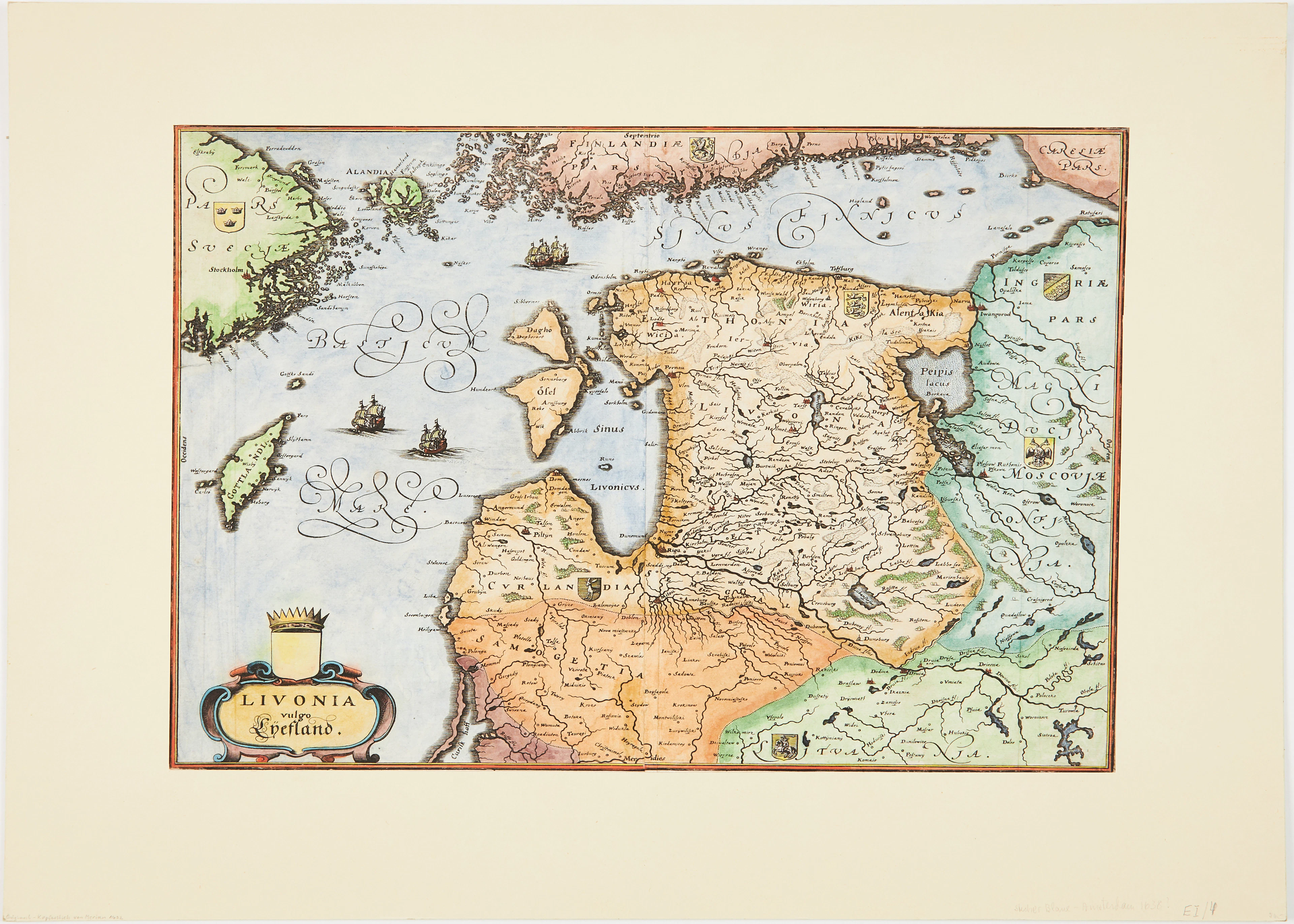
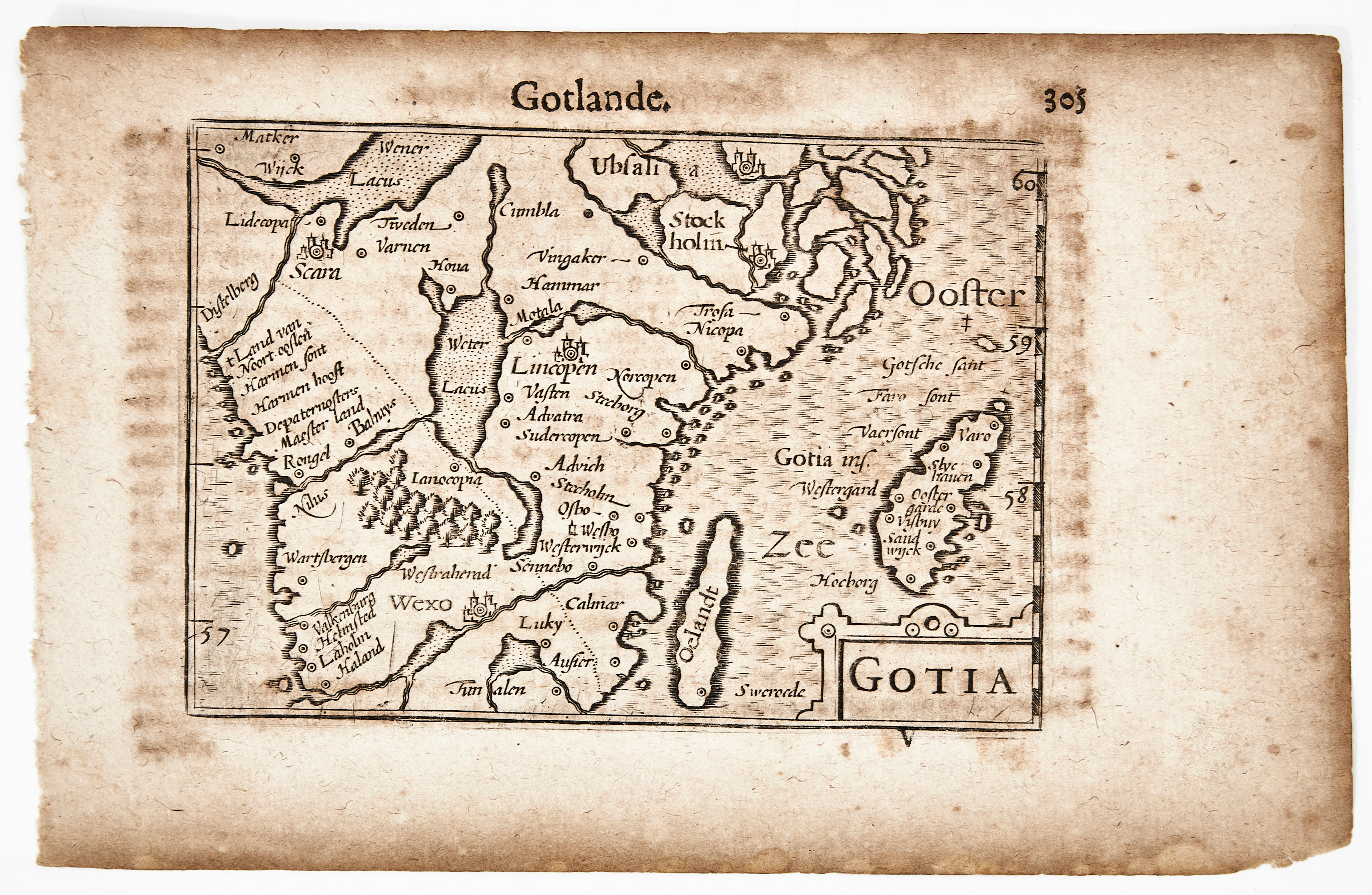
BERTIUS KARTA ÖVER GÖTALAND, Gotia, ca 1670.
10/07/2026
€90.34
Est. : €106.64
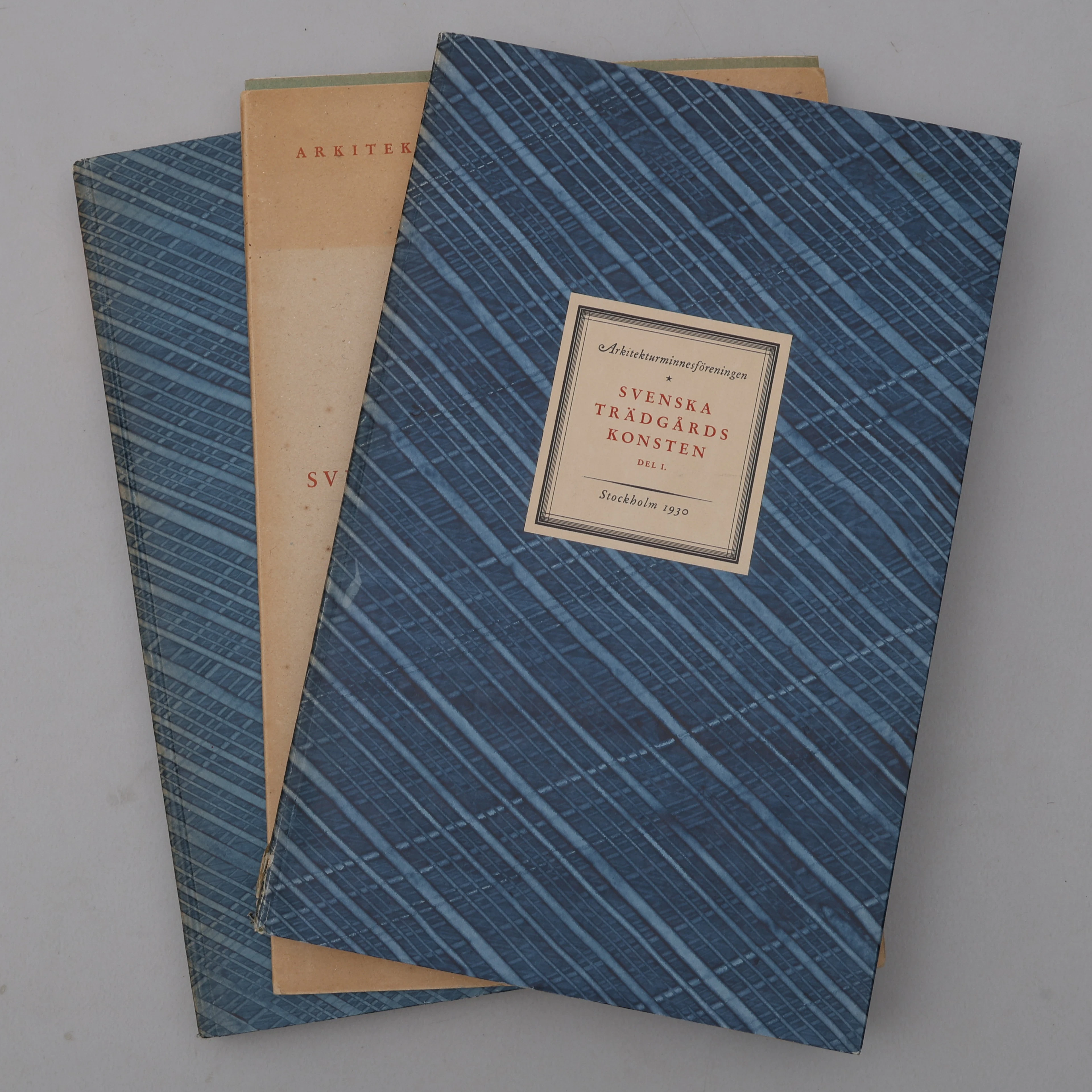
BIBLIOFILI/TRÄDGÅRD. SVENSKA TRÄDGÅRDSKONSTEN SÅDAN DEN TILL VÅRA
10/07/2026
€98.39
Est. : €266.61

SLOTT OCH HERRESÄTEN I SVERIGE, 18 VOLYMER, Malmö, 1966-71.
10/07/2026
€71.55
Est. : €133.3
Présentez votre vente aux enchères à des collectionneurs du monde entier !
Soyez référencé dès maintenantEn vous abonnant, vous acceptez la politique de confidentialité. Désabonnez-vous à tout moment.
Barnebys HQ
Brahegatan 10
BOX 5038
114 37 Stockholm
