


Toutes les enchères / Art Ancien / Central Europe – Late Middle Bronze Age to Early Urnfield...

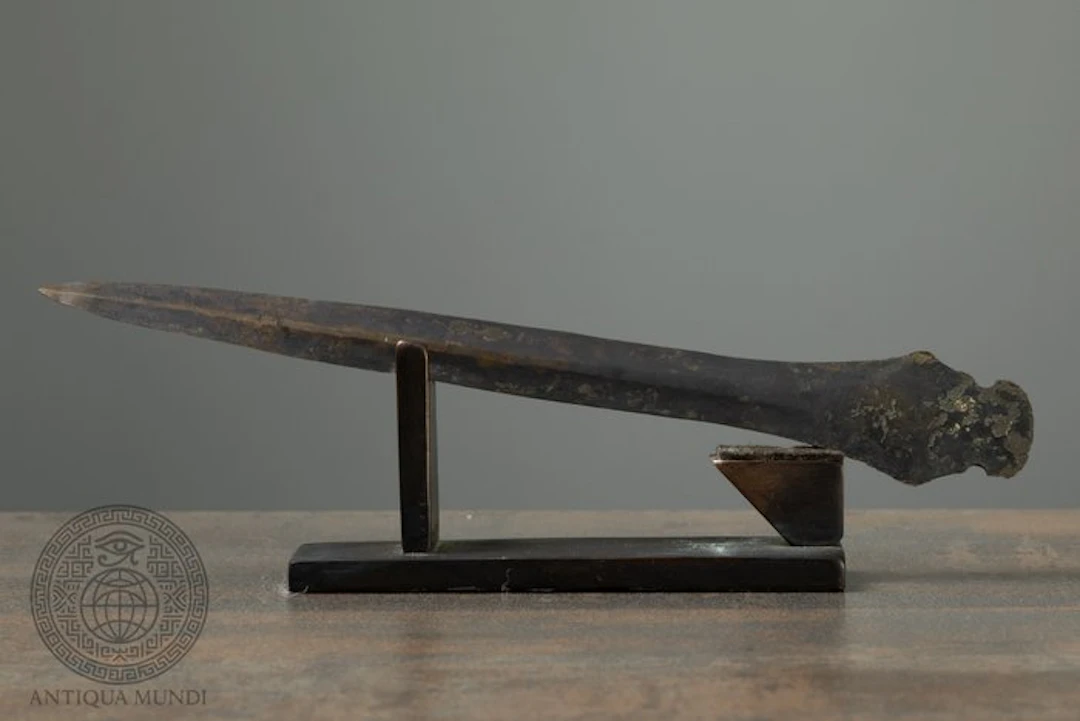
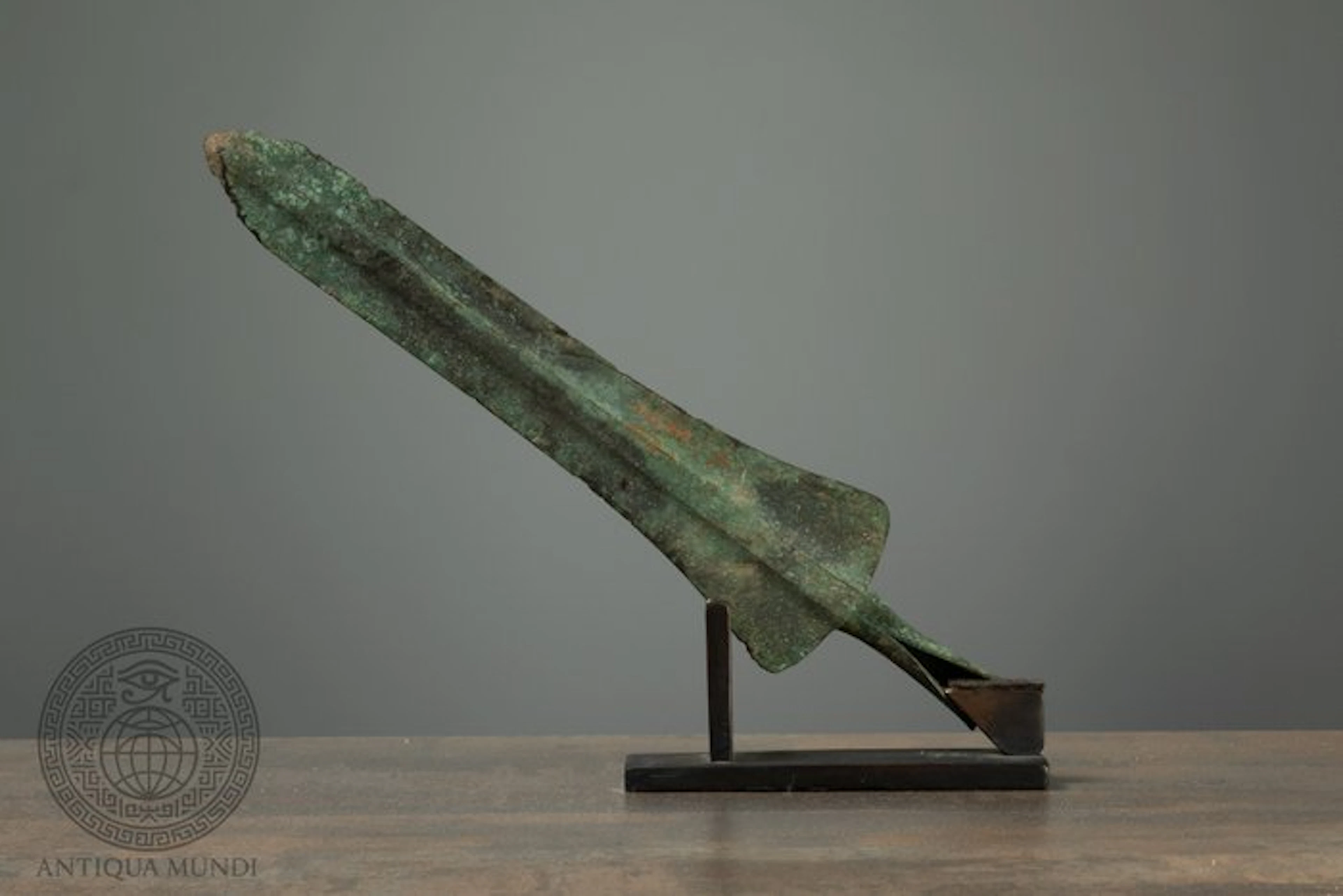
A large and impressive Central European bronze dagger with a long double-edged blade, strongly pronounced central midrib and broad flat tang, attributed to the Late Middle Bronze Age to Early Urnfield Period, circa 1400–1200 BC. The elongated blade tapers gradually and symmetrically towards the point. Its most distinctive feature is the powerful axial midrib, which runs along almost the entire length of the blade. The blade surfaces slope from this raised central reinforcement towards the cutting edges, creating a strongly profiled, approximately diamond-shaped cross-section. This construction provided additional rigidity while maintaining the relatively slender proportions of the weapon. Towards the base, the blade narrows at the shoulders before expanding into a broad, flat tang with a distinctive shaped outline and lateral indentations. The tang originally formed the core of a separately constructed handle. Grip elements made from an organic material such as wood, bone or horn would have been attached to this section but have not survived. The transition between the narrow blade, pronounced shoulders and broad tang is particularly characteristic and gives the weapon a clearly defined profile. With a preserved length of approximately 25 cm, this is a substantial example of a Bronze Age dagger. Typology and Dating Daggers with flat tangs and separately attached organic grips formed an established part of the weapon repertoire of Bronze Age Central Europe. The combination of a long double-edged blade, pronounced axial midrib and broad shaped tang is consistent with traditions represented during the Middle and Late Bronze Age and continuing into the beginning of the Urnfield period. On typological grounds, a dating to approximately 1400–1200 BC appears plausible for the present example. The attribution is based on the morphology and construction of the weapon. In the absence of a documented archaeological find context, a more precise regional or chronological classification should remain open. The piece should therefore be regarded as a Central European Bronze Age flat-tanged dagger, rather than being assigned to the considerably later Hallstatt weapon tradition. Function The dagger was originally equipped with a separately attached handle of organic material. The broad tang provided the support for this grip, while the pronounced central midrib reinforced the long bronze blade. Such daggers were functional weapons but could also form an important element of personal equipment during the Bronze Age. The considerable dimensions and strongly modelled blade give the present example a particularly imposing appearance. Surface and Patina The bronze displays an attractive dark brown to almost black-brown patina, with areas of lighter brown oxidation and mineral deposits. The raised central rib remains clearly visible on both sides of the blade. Age-related variations in the surface, corrosion and mineral accretions emphasise the ancient character of the object. Condition Good and substantially complete considering its considerable age. The blade is preserved with a slightly rounded point. The cutting edges show age-related irregularities, corrosion and small areas of material loss. The broad tang is preserved, although its outer edges display old losses and irregularities. The original organic handle or grip plates are no longer present. Age-related surface corrosion, wear and mineral deposits are visible throughout. The bronze retains an attractive, naturally developed dark patina. No obvious modern additions or extensive restorations are identifiable from the available photographs. Please examine all photographs carefully, as they form an integral part of the condition description. Display If shown mounted in the photographs, the modern display stand is used solely for presentation and is not included in the sale. Provenance Formerly in the Madeleine & Erich Dammann Collection, Germany. Acquired during the collectors’ extensive travels between 1950 and 1970. The collection is documented in Germany by 1970 through historical photographs of the family residence and subsequently remained in continuous family ownership. The objects were acquired privately during the collectors’ travels. As was customary for private purchases made at local markets during the 1950s and 1960s, purchase receipts or invoices were generally neither issued nor requested. Historical photographs and biographical documentation relating to the Dammann Collection are available and support the long-standing provenance of the collection.
Estimation:€400
Vers la vente aux enchèresVoir tous les objets deCatawikiouArt Ancien
Estimation:
€400
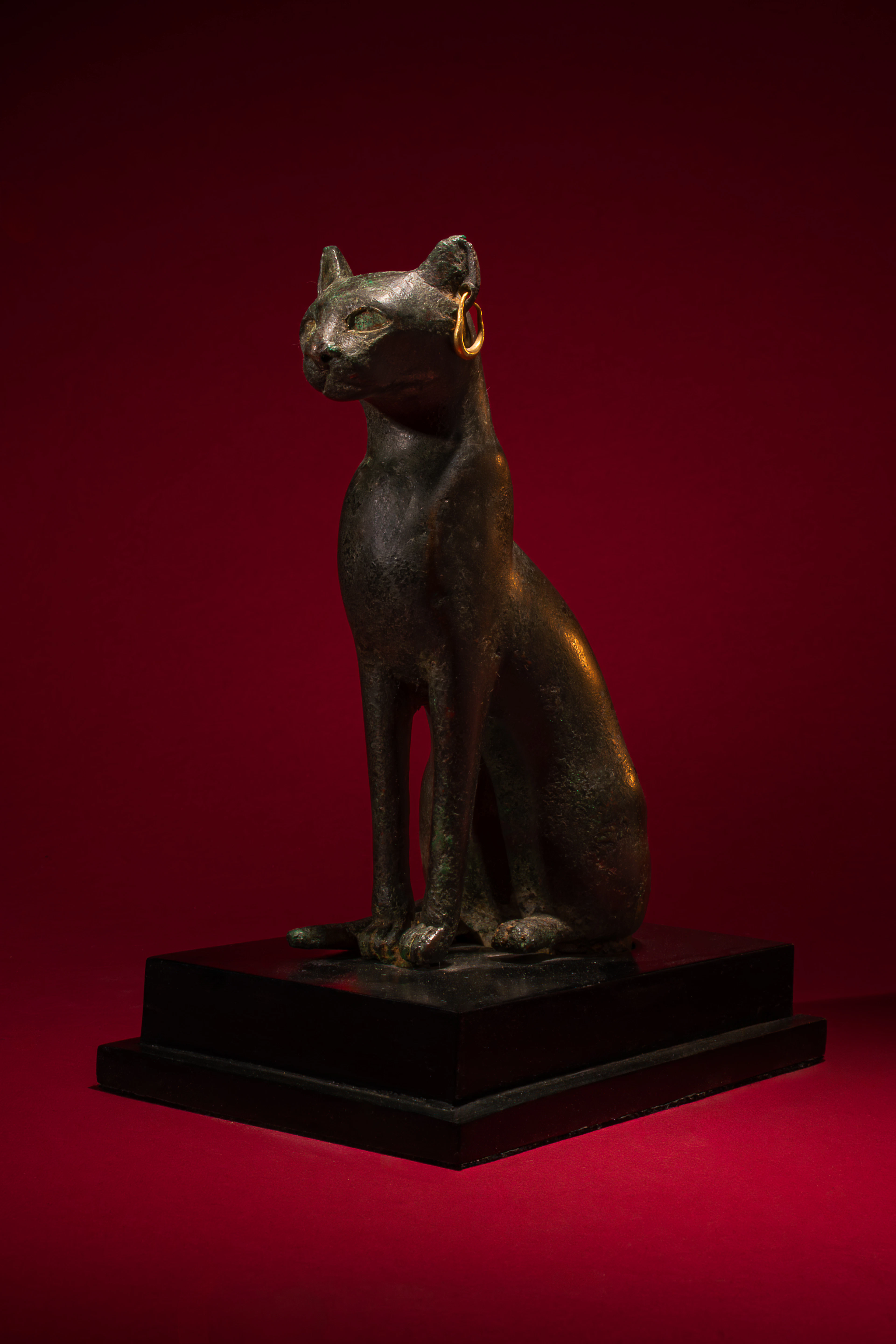
RARE EGYPTIAN BRONZE CAT STATUETTE WITH GOLD EARRINGS - LARGE SIZE
06/21/2026

€25,506.4
Est. : €23,095.64
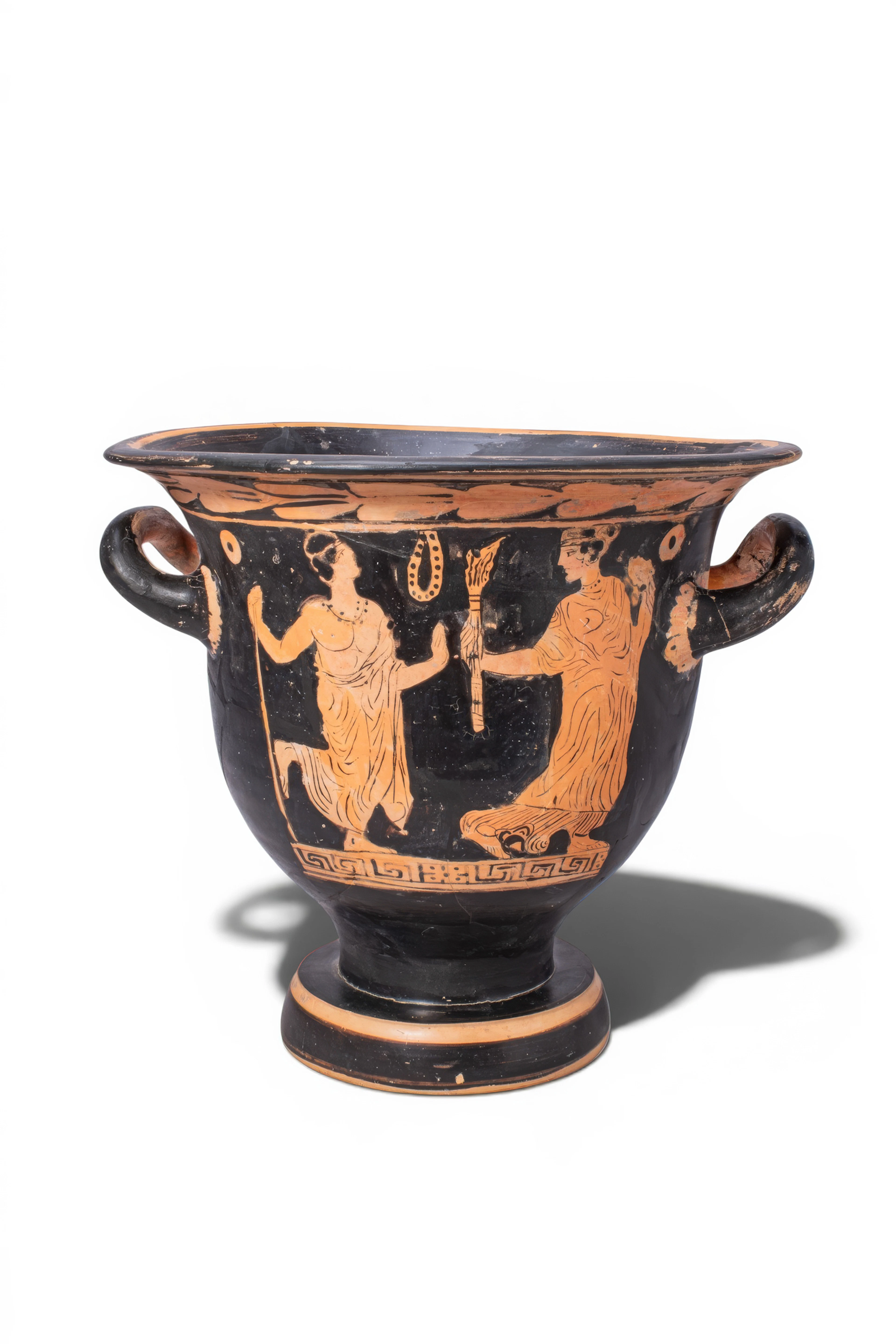
APULIAN RED-FIGURE BELL KRATER WITH KOMASTOS AND MAENAD - TL TESTED
06/21/2026
€3,014.39
Est. : €2,304.2




OCT 23 | 8:00 AM
Présentez votre vente aux enchères à des collectionneurs du monde entier !
Soyez référencé dès maintenantEn vous abonnant, vous acceptez la politique de confidentialité. Désabonnez-vous à tout moment.
Barnebys HQ
Brahegatan 10
BOX 5038
114 37 Stockholm
