


Toutes les enchères / Art Ancien / Ancient Roman

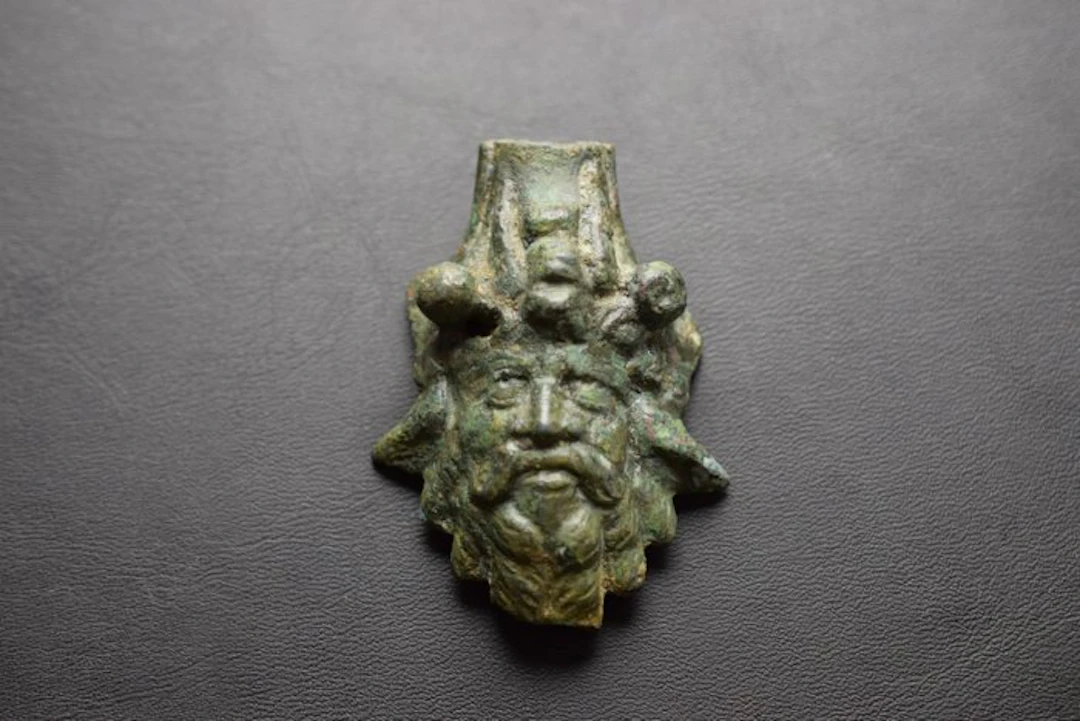
Ancient Roman Bronze Vessel Handle Attachment Depicting Dionysus Roman Imperial Period, circa 1st–3rd Century AD Material: Bronze Weight: 71.3 g Dimensions: 61.0 × 46.0 × 22.2 mm Condition: Excellent for the type, with a magnificent ancient green, olive and turquoise patina with natural earthen deposits. From a Private European Collection. An exceptionally attractive and very rare Ancient Roman bronze vessel handle attachment depicting the bearded Dionysus, the Greek god of wine, fertility, theatre and ecstatic celebration, known to the Romans as Bacchus. The remarkably expressive head of the god is rendered in powerful high relief. Dionysus is shown with heavy-lidded eyes, a prominent nose, an imposing sweeping moustache and a luxuriant beard, creating an impressive and almost theatrical appearance. Of particular importance are the ornaments surrounding the head. Two prominent rounded elements project symmetrically on either side and appear to represent grapes or clusters of fruit, accompanied by luxuriant vegetal and foliate forms. This combination of grapes, vegetation and the imposing bearded divine head strongly evokes the iconographic world of Dionysus and his association with vines, wine and abundance. The result is an exceptionally evocative image of the god emerging from the vegetation associated with his cult. Dionysus – God of Wine, Theatre and Ecstasy: Dionysus was one of the most fascinating and complex deities of the ancient Mediterranean world. Known as Bacchus to the Romans, he ruled over wine and viticulture, fertility, theatre, ecstatic celebration and the temporary liberation from the conventions of ordinary life. His cult spread throughout the Greek and Roman worlds, and Dionysiac imagery became enormously popular in Roman art. Dionysus was frequently surrounded by vines, grapes and luxuriant vegetation, symbols not merely of wine but also of fertility, abundance and the regenerative powers of nature. His mythical entourage included satyrs, Silenus and maenads, whose revelries became one of the most recognizable subjects of classical art. The bearded appearance of the present figure is particularly fascinating. Although later Classical representations frequently depict Dionysus as a youthful and almost androgynous deity, the older Greek iconographic tradition portrayed Dionysus as a mature, imposing bearded god. This archaizing conception of the deity continued to influence later Greek and Roman art. The striking combination of the mature bearded face and probable grape or fruit ornamentation therefore makes the Dionysiac character of this remarkable bronze particularly compelling. Dionysus and the Roman Banquet: The presence of Dionysus on a vessel fitting would have been especially appropriate. Wine occupied a central position in Roman dining culture, particularly during the convivium, the Roman banquet. Drinking vessels, jugs, kraters and other luxurious bronze objects were therefore frequently decorated with imagery connected with Dionysus and his mythical world. Such decoration transformed an everyday functional object into something considerably more sophisticated. The image of the god of wine upon a vessel associated with drinking and banqueting created a deliberate visual connection between the object, its contents and the divine sphere of Dionysus. The present bronze most probably once formed the elaborate lower attachment or terminal of a substantial bronze vessel handle. Its deeply hollowed reverse is consistent with its original function as an applied fitting, while the massive surviving upper section indicates that the original handle continued above the decorative terminal. The complete vessel must once have presented an impressive appearance. An Exceptional Piece of Roman Decorative Bronze Work: At 61 mm in height, 46 mm in width and weighing 71.3 g, this is a substantial piece of cast bronze rather than a lightweight decorative applique. The considerable depth of 22.2 mm, strongly projecting fruit-like ornaments and deeply modelled facial features give the object an impressive three-dimensional and almost sculptural character. Especially remarkable is its magnificent naturally developed ancient patina. Rich shades of olive and deep green are interspersed with turquoise mineralization and natural earthen deposits, beautifully emphasizing the relief and providing the object with exceptional archaeological character. Despite the loss of the original vessel and the remainder of the handle, its most important decorative component has survived: the imposing bearded image of Dionysus surrounded by the symbols of his world. A very rare, highly decorative and exceptionally evocative Roman bronze, combining the image of Dionysus with the ancient culture of wine, abundance and the Roman banquet – a fascinating survival from the private artistic world of the Roman Empire nearly two thousand years ago. I prove that the lot was obtained legally , provenance statement seen by Catawiki Important information. I guarantee that I am entitled to ship this lot. I will take care that any necessary permits will be arranged. I will inform the buyer about this if this takes more than a few days.
Estimation:€300
Vers la vente aux enchèresVoir tous les objets deCatawikiouArt Ancien
Estimation:
€300
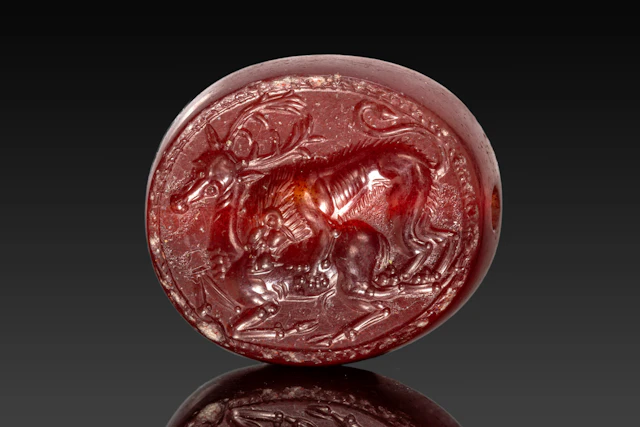
ETRUSCAN CARNELIAN STAMP SEAL WITH A LION ATTACKING A STAG
06/21/2026

€5,796.91
Est. : €5,773.91
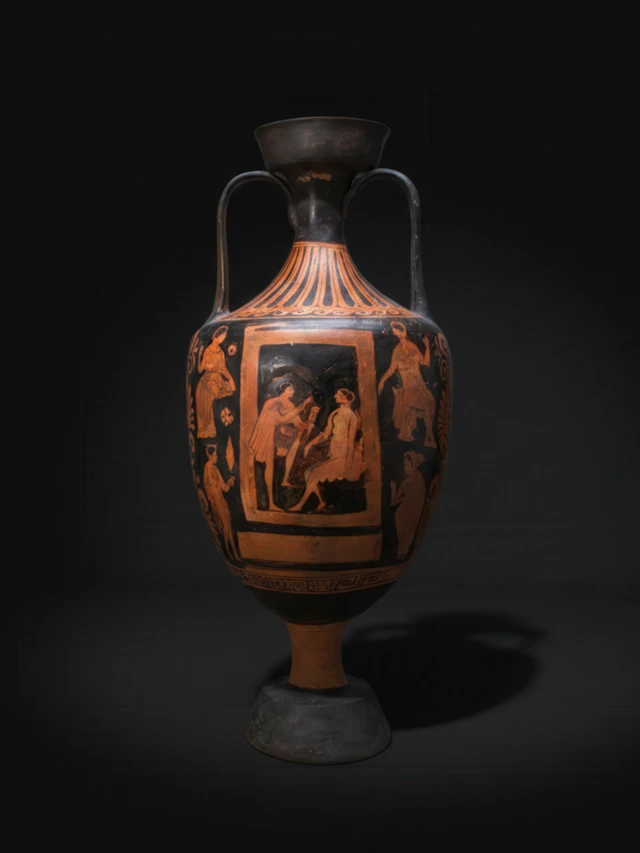
LARGE APULIAN RED-FIGURE AMPHORA WITH NAISKOS SCENE AND ALTAR
06/21/2026
€6,376.6
Est. : €5,773.91




OCT 27 | 4:00 PM
Présentez votre vente aux enchères à des collectionneurs du monde entier !
Soyez référencé dès maintenantEn vous abonnant, vous acceptez la politique de confidentialité. Désabonnez-vous à tout moment.
Barnebys HQ
Brahegatan 10
BOX 5038
114 37 Stockholm
