


Présentez votre vente aux enchères à des collectionneurs du monde entier !
Soyez référencé dès maintenantEn vous abonnant, vous acceptez la politique de confidentialité. Désabonnez-vous à tout moment.
Barnebys HQ
Brahegatan 10
BOX 5038
114 37 Stockholm
Toutes les enchères / Art Ancien / Ancient Roman

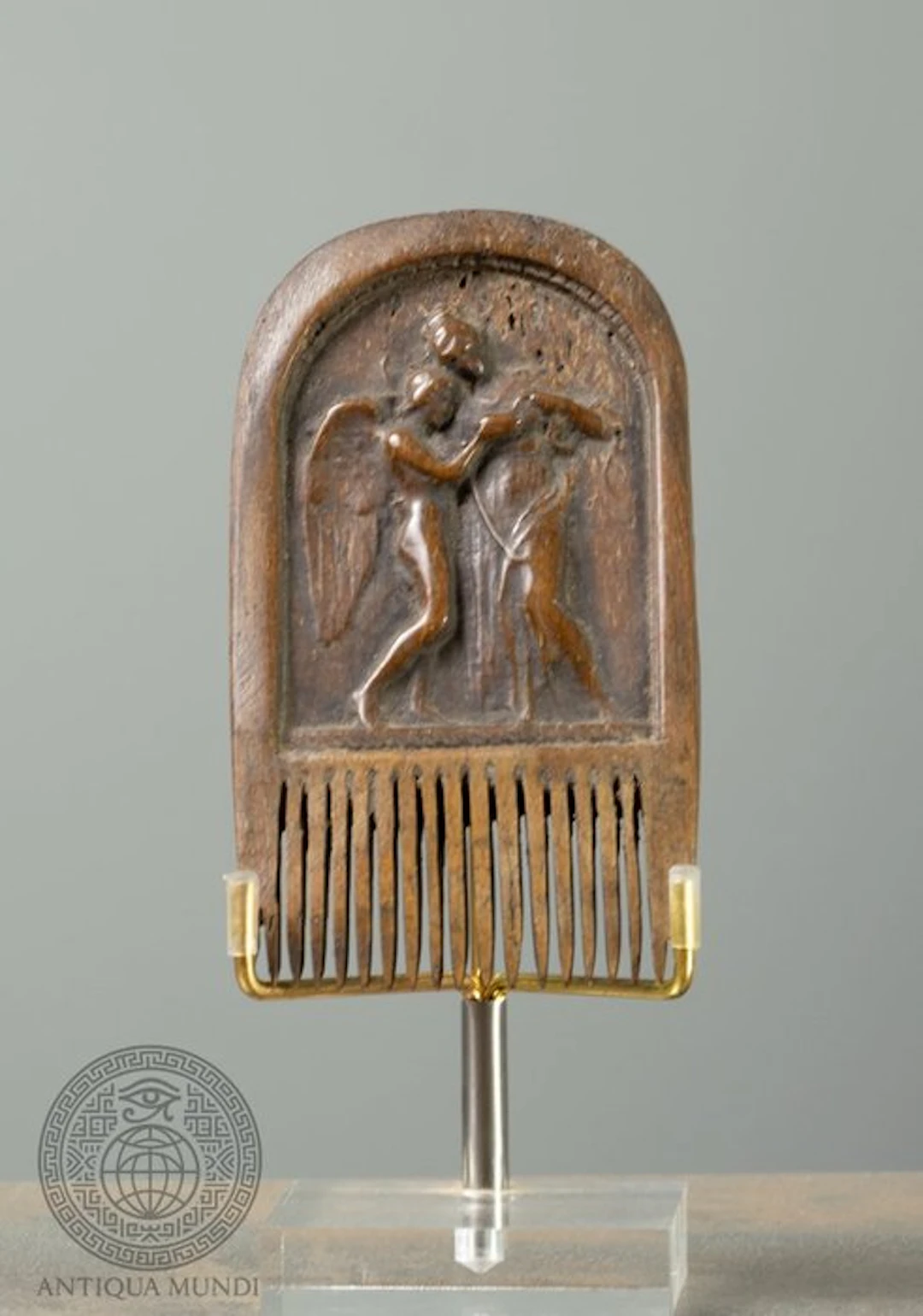
An unusual and finely carved Late Antique bone comb, distinguished by an elaborate figural relief and a deep dark-brown to chestnut-brown age patina. The comb has a tall rectangular body terminating in a rounded, arched upper section. The lower part is worked into a row of long, narrow and closely spaced comb teeth. Above the teeth is a large recessed pictorial field enclosed by a pronounced arched border. The relief depicts two confronting figures. On the left is a slender, largely unclothed or lightly draped winged figure. A large wing extending downward behind the body is clearly visible. The figure is shown in a slightly animated stance, with the legs positioned apart. The prominent wing suggests a possible identification with Nike, or Victoria in Roman iconography, the personification of victory. As no additional diagnostic attributes are clearly preserved, this identification should be regarded as probable rather than certain. Opposite stands a second, unwinged figure wearing a long garment extending towards the ground. The two figures interact closely. One arm of the draped figure appears to reach towards or touch the winged figure around the shoulder or upper body. Between them is a tall, narrow vertical element over which the other arm appears to extend. This element may represent an altar, cult stand, column or related ceremonial object. A further small object may originally have been held by the extended hand. The composition may therefore represent a ceremonial, ritual or mythological scene, although the precise subject cannot be securely identified from the surviving attributes alone. The figural scene is framed by a substantial arched moulding. The heads, arms and body contours are carved in relief against the recessed background. Particularly striking is the large wing of the left-hand figure. The long garment of the second figure is articulated by a series of vertical incisions suggesting folds of fabric. Immediately below the relief begins the functional section of the object, consisting of the long and closely spaced teeth of the comb. The front has been carefully smoothed and displays a rich dark-brown to chestnut-brown patina. Raised areas of the carving are lighter in places as a result of age and surface wear. The undecorated reverse displays the naturally porous and irregular structure of the bone, with numerous small cavities, pits and age-related surface irregularities. Winged female figures formed an important part of Mediterranean imagery from Classical Antiquity onwards. Nike, known as Victoria in the Roman world, was traditionally represented as a winged female figure and continued to appear in various forms during Late Antiquity. The winged figure on the present comb may belong to this iconographic tradition. The identity of the second figure remains uncertain. In the absence of an inscription or sufficiently distinctive attributes, identification with a particular deity or mythological figure would be speculative. Carved bone combs were functional objects used for personal grooming, but richly decorated examples could also serve as prestigious personal possessions. The comparatively elaborate figural composition of the present example goes considerably beyond the decoration of a simple utilitarian comb and reflects the continuing use of Classical imagery in Late Antique decorative arts. Age-related condition with a dark brown patina, surface wear, minor chips and naturally occurring irregularities in the bone. The reverse displays pronounced porosity with numerous small cavities and pits. The figural relief remains clearly legible. The principal elements of the composition – the two figures, the large wing, their arms, the drapery and the central vertical element – remain visible. The majority of the comb teeth are preserved, with some showing minor age-related losses, shortening and irregularities. Provenance: Formerly in the Madeleine & Erich Dammann Collection, Germany. Acquired during the owners' extensive travels between 1950 and 1970. The collection has been documented in Germany since 1970 and remained in continuous family ownership thereafter. As was customary for private purchases made in local markets during the 1950s–1970s, purchase receipts or invoices were generally neither issued nor requested. The provenance is documented through continuous family ownership, historical photographs and supporting biographical records.
Estimation:€600
Vers la vente aux enchèresVoir tous les objets deCatawikiouArt Ancien
Estimation:
€600
EGYPTIAN BRONZE INLAID APPLIQUE OF URAEUS - MUSEUM EXHIBITED
06/21/2026

€1,623.13
Est. : €1,154.78
Présentez votre vente aux enchères à des collectionneurs du monde entier !
Soyez référencé dès maintenant€275