




Toutes les enchères / Ethnographie / A bronze vessel - Benin - Nigeria

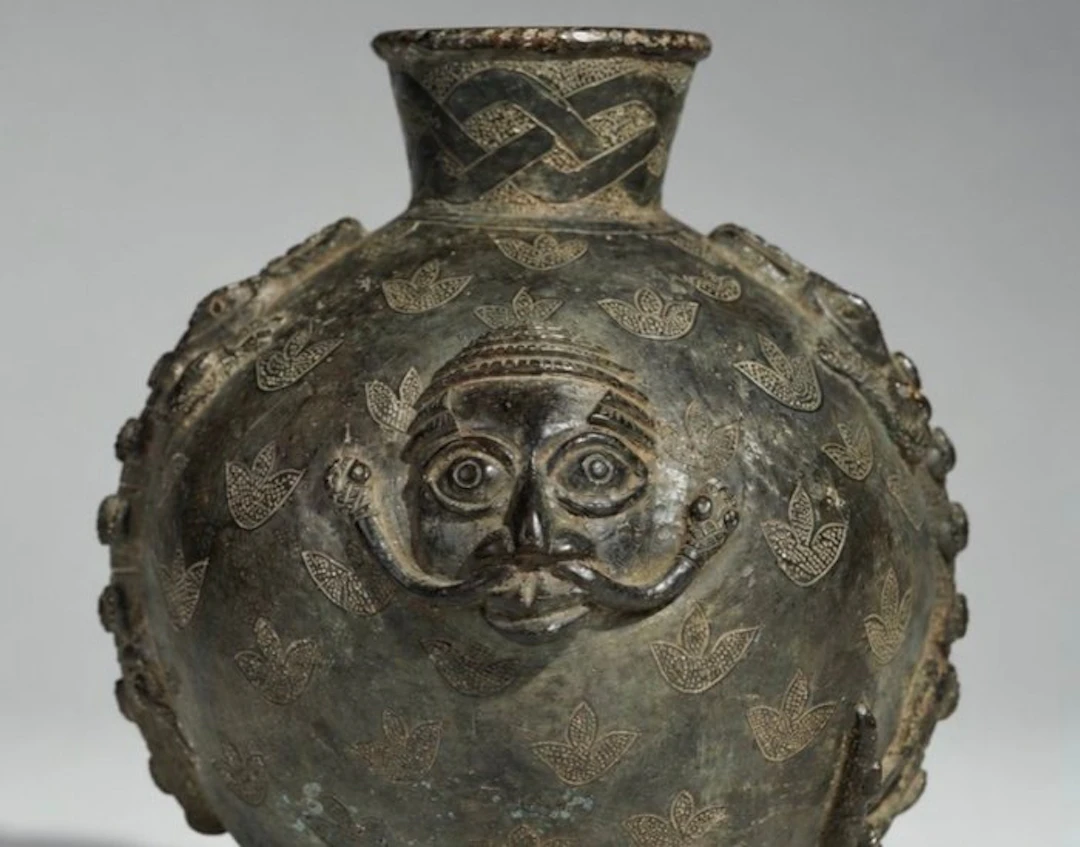
Benin Bronze Vessel with Anthropomorphic Masks, Crocodile and Ram’s Head Culture: Edo, Kingdom of Benin, present-day Edo State, Nigeria – stylistic attribution Material: Copper alloy, probably brass, cast and chased Technique: Presumably lost-wax casting (cire perdue) Date: Undetermined; historical or later production No scientific test report is provided for this piece. Its age and geographical origin have therefore not been verified. Dimensions: Height: 17 cm, Dimension 14 cm, Weight: 1,8 kg, witout stand Inv. No. MAZ30900a This elaborately ornamented metal vessel is distinguished by its almost spherical, slightly compressed body, gently sloping shoulders and short, outward-flaring cylindrical neck. The mouth is bordered by a prominent rope-twist moulding, while the neck is encircled by a continuous interlaced band composed of broad, overlapping ribbons against a finely stippled ground. The surface displays a dark brown to greenish-black patination, with areas of exposed, warmer-toned metal and scattered traces of oxidation. Particularly striking is the integration of boldly modelled figural reliefs within an otherwise continuous ornamental scheme. Two opposing sides are dominated by projecting anthropomorphic faces, their features rendered with considerable sculptural emphasis. Large, circular eyes, defined by concentric raised contours, lend the faces an intensely animated expression, while prominent noses, full lips and carefully articulated facial details contribute to their distinctive appearance. Curving elements extend from the corners of the mouths towards the cheeks and temples, possibly representing stylised facial hair, ceremonial adornments or other conventionalised attributes. The foreheads and coiffures are marked by closely spaced parallel ridges, introducing a further dimension of textural refinement. Between the anthropomorphic faces appear two contrasting zoomorphic representations. One depicts a crocodile-like creature with an elongated, segmented body, four splayed limbs and a long, curling tail. Its textured dorsal surface, prominent protrusions and elongated head reinforce the identification as a crocodile. On the opposite side, a projecting animal head with strongly curved, ribbed horns is most plausibly interpreted as a ram. The intervening areas of the vessel are densely ornamented with small, regularly distributed trefoil or leaf-like motifs, each defined by incised outlines and finely stippled interiors. These motifs extend across the shoulders and rounded body, establishing a rhythmic continuity between the principal figural compositions. The resulting interplay of relief, texture and ornament gives the vessel a richly articulated sculptural presence, inviting examination from every angle. Art-Historical Context The juxtaposition of anthropomorphic and zoomorphic imagery against meticulously ornamented surfaces is characteristic of important strands of the metalworking traditions associated with the Kingdom of Benin. From at least the fifteenth century onwards, Edo brasscasters developed a sophisticated artistic vocabulary in which human figures, animals, regalia and ornamental devices could articulate concepts of kingship, social hierarchy, ancestral authority and spiritual power. Within this broader visual tradition, the present vessel is notable for its synthesis of a compact, architecturally balanced form with an unusually animated programme of sculptural decoration. The projecting masks and animals interrupt the continuity of the rounded surface without compromising its underlying symmetry, while the repeated foliate motifs create a unifying ornamental field. Such an approach finds parallels in historical Benin metalwork, where raised figural compositions are frequently juxtaposed with carefully worked backgrounds. The vessel's decoration is nevertheless sufficiently individual to warrant caution in assigning it to a particular period or workshop. Although its formal vocabulary is consistent with the broader Edo artistic tradition, stylistic affinities alone cannot establish production within the historical royal court, nor can they demonstrate a date preceding the British conquest of Benin in 1897. Benin-inspired brasscasting continued during the colonial and postcolonial periods, with workshops preserving, adapting and recombining established forms and iconographic conventions. A more precise chronological assessment would require close examination of the casting structure, alloy composition, interior surfaces, patination and documented collecting history. Comparative Examples and Digital Benin A particularly relevant typological comparison is a spherical brass vessel in the British Museum, London, inventory number Af1949,46.159, attributed to the Edo culture and broadly dated to the sixteenth through nineteenth centuries. Measuring approximately 27 cm in height, the British Museum example likewise possesses a compact, rounded body, a short neck and an elaborate decorative programme combining zoomorphic imagery with interlaced and stippled ornament. Its decoration includes leopards, frogs and other motifs arranged across the vessel's curved surface. The parallels are especially evident in the overall conception of the container as a continuous sculptural field, where figural imagery and geometric patterning are integrated into a unified composition. The present example, however, differs in its greater emphasis on a small number of prominently projecting anthropomorphic and zoomorphic elements. Further comparative material is found in Augustus Henry Lane-Fox Pitt-Rivers's pioneering publication Antique Works of Art from Benin (1900), which illustrates a variety of richly decorated metal vessels incorporating human figures, serpentine creatures and other animal forms. These early records are particularly valuable in demonstrating the historical presence of complex figural programmes on cast-metal containers associated with Benin. Comparable traditions are also represented among historical Benin metal vessels preserved in Nigerian collections, although individual examples vary considerably in form, construction and functional arrangement. The Digital Benin research platform provides an essential framework for situating such works within the wider corpus of objects dispersed across international museum collections. By bringing together institutional records, historical classifications and provenance information, the database facilitates systematic comparison between vessel forms, ornamental conventions and iconographic elements. At present, however, no securely documented object in the available Digital Benin records can be identified as an exact formal and iconographic counterpart to the present vessel. The cited examples should therefore be understood as comparative evidence for an artistic tradition rather than as direct models or definitive indicators of d Iconography and Symbolism The combination of human and animal imagery invites interpretation within the symbolic traditions of the Benin court, where representations of particular creatures could communicate ideas of authority, supernatural protection and the relationship between terrestrial and spiritual realms. Crocodiles and other aquatic animals occupy a significant position within the visual culture of Benin, particularly through associations with water, spiritual potency and the domain of Olokun, the deity connected with the sea, wealth and prosperity. In this context, the crocodile represented on the vessel may evoke concepts extending beyond its purely naturalistic identity, although a specific symbolic function cannot be established with certainty. The projecting human faces are similarly open to several interpretations. Their pronounced eyes, carefully articulated coiffures and distinctive facial embellishments may suggest figures invested with social or spiritual significance, yet the absence of unambiguous identifying attributes precludes their association with a particular ruler, ancestor or deity. The ram's head introduces another element into the iconographic composition. While the ram may be interpreted more broadly in terms of vigour, strength and assertive energy, its precise significance within this particular ensemble remains uncertain. Equally, the repeated trefoil motifs, although visually suggestive of vegetal forms, should not automatically be assigned a specific religious or fertility-related meaning. Their primary demonstrable function is ornamental: they organise the vessel's surface, mediate between the larger sculptural elements and contribute to the overall coherence of the composition. Considered together, the imagery suggests an interest in the interrelationship of human authority, animal potency and the natural world, without permitting a definitive reconstruction of the vessel's intended symbolic programme. Possible Function and Cultural Significance The vessel's elaborate decoration and technically demanding manufacture suggest that it was conceived as an object of considerable visual and possibly social significance. Historical Benin metal vessels fulfilled a range of functions, including the containment, presentation and ceremonial handling of liquids or other substances, while certain forms were associated with elite or royal environments. The celebrated cast-metal aquamanilia of Benin, including the Leopard Aquamanile in the Metropolitan Museum of Art, demonstrate the importance of sculpturally conceived containers within the artistic and ceremonial repertoire of the Edo. Nevertheless, the specific function of the present vessel cannot be established from its exterior appearance alone. Its short, comparatively open neck and rounded body are compatible with a container intended to hold or present contents, but there is insufficient evidence to determine whether it served a domestic, prestigious or ritual purpose. Nor can its elaborate iconography, in isolation, substantiate an association with a particular shrine or court ceremony. The possibility of ceremonial use remains plausible, but should be understood as a hypothesis rather than a documented fact. Art-Historical Appreciation The vessel derives much of its aesthetic distinction from the sophisticated relationship between an emphatically rounded body and the sculptural elements that project from its surface. Its compact silhouette provides a restrained formal framework for an animated decorative programme in which anthropomorphic masks, animal imagery and intricately worked ornamental motifs are brought into close visual dialogue. The contrasting scales of the principal figures and the repeated trefoil patterns create a compelling rhythm, while the interplay of smooth, patinated surfaces and textured relief contributes to the object's sculptural richness. Particularly effective is the conception of the vessel as a three-dimensional composition: rather than privileging a single frontal viewpoint, the decoration unfolds around the circumference, revealing successive figurative motifs as the object is turned. This integration of form, ornament and imagery connects the work to the broader aesthetic principles of Edo metalworking and the artistic traditions associated with the Kingdom of Benin. Its precise date and place of manufacture remain to be established, and the available photographic evidence does not justify attribution to a particular historical royal workshop. Nevertheless, the vessel represents an accomplished interpretation of the formal and iconographic vocabulary of Benin brasscasting, distinguished by the expressive modelling of its figural reliefs, the density of its ornamentation and the carefully balanced relationship between sculptural projection and underlying geometric form. Literature and Comparative Objects Augustus Henry Lane-Fox Pitt-Rivers: Antique Works of Art from Benin, London, 1900, particularly Plates VIII and XXIV. Barbara Plankensteiner (ed.): Benin: Kings and Rituals. Court Arts from Nigeria, Ghent, 2007. Kathryn Wysocki Gunsch: The Benin Plaques: A 16th Century Imperial Monument, London/New York, 2018. British Museum, London, Inventory No. Af1949,46.159, Spherical Brass Vessel, Edo, Benin, sixteenth–nineteenth century. Metropolitan Museum of Art, New York, Accession No. 1991.17.58a, b, Leopard Aquamanile, Edo, Benin, sixteenth–nineteenth century. Digital Benin: International digital research and collection database documenting the historical art and cultural heritage of the Kingdom of Benin. www.digitalbenin.org Copyright and Scientific Documentation Some of the information and photographs have been generated with the assistance of artificial intelligence and are based on published sources in ethnography, archaeology, and art history. Original texts and photographs may be protected by copyright. All rights held by the respective rights holders are reserved.
Estimation:€1,400
Vers la vente aux enchèresVoir tous les objets deCatawikiouEthnographie
Estimation:
€1,400
Présentez votre vente aux enchères à des collectionneurs du monde entier !
Soyez référencé dès maintenantEn vous abonnant, vous acceptez la politique de confidentialité. Désabonnez-vous à tout moment.
Barnebys HQ
Brahegatan 10
BOX 5038
114 37 Stockholm
