




Toutes les enchères / Ethnographie / A beads sculpture - Yoruba - Nigeria (No reserve price)

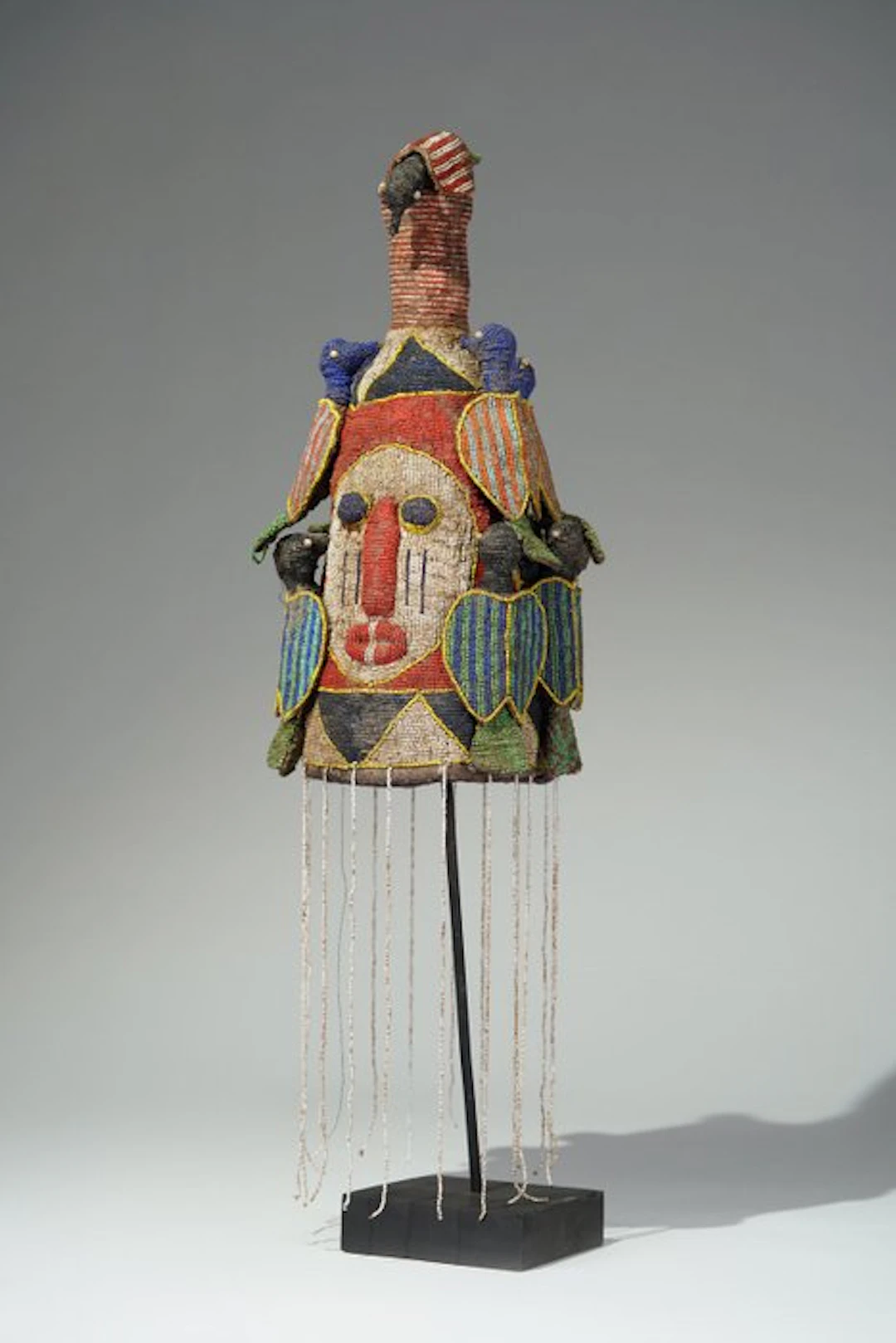
Yoruba Beaded Crown - Osogbo Region, Nigeria, incl stand. This tall, conical piece is entirely covered with colored glass beads. Its front is dominated by a large, stylized face with circular eyes, a long red nose, and a three-dimensional mouth. Numerous small, three-dimensional figures and bird-like creatures in blue, green, and black are arranged along the sides; above this rises a slender, red-and-white striped finial, which is itself crowned by a bird. Triangular and linear patterns structure the dense surface. Long, light-colored strands of beads hang from the lower edge, originally forming a movable veil in front of the wearer's face. Formally, the piece belongs to the tradition of royal Yoruba beaded crowns (adé, especially adéńlá). A comparable example from the Osogbo region is in the Metropolitan Museum of Art. Such crowns are among the most important insignia of an ọba (royal prince) and combine royal authority with sacred lineage. The beaded veil conceals the ruler's individual face, while birds in the crown iconography allude, among other things, to feminine spiritual power and the legitimation of royal authority. However, the exceptionally rich number of figures in this work makes a precise interpretation of individual motifs uncertain without documented provenance. Literature (selection): Henry J. Drewal / John Pemberton III / Rowland Abiodun: Yoruba: Nine Centuries of African Art and Thought. New York 1989. John Pemberton III: African Beaded Art: Power and Adornment. Northampton 2008. Babatunde Lawal: Visions of Africa: Yoruba. Milan 2012. THE PHOTO Beyond the Museum: Tradition as a Living Visual Language The photograph takes as its point of departure the tradition of royal Yoruba beaded crowns, yet resists an interpretation that defines the object solely through provenance, typology, or its classification within an ethnographic or art-historical canon. The crown appears neither as an isolated museum object nor as part of a reconstructed historical ceremony. Instead, it becomes the centre of a new and distinctly contemporary pictorial reality, in which body, object, and space merge into an autonomous visual presence. In this sense, the image moves beyond a narrowly postcolonial perspective. It does not limit itself to questioning colonial regimes of representation or reversing the Western musealisation of African art. Rather, it challenges the assumption that the object must continue to be understood within this historical opposition—between African origin on the one hand and Western collection and interpretation on the other. The crown is released from such systems of cultural classification and transferred into an open, contemporary visual space. The relationship between body and crown is crucial to this transformation. Whereas museum displays tend to fix such an object through vitrines, pedestals, labels, and cultural attribution, separating it from the body and from the performative dimension of its original use, the photograph restores corporeal presence to the centre of the image. The crown is worn; its long strands of beads fall across the face, while its ornamental structures continue into the garment. Yet this is not an attempt at historical reconstruction. The figure does not serve to illustrate the function of an ethnographic artefact. Instead, body, crown, and clothing form a new and autonomous appearance. The setting similarly resists any clear geographical or cultural localisation. The weathered architecture does not function as the backdrop for an imagined authentic past, but as a temporally open space of resonance. Light entering from the side gives the central figure an almost sculptural presence, while the blurred figure in the background introduces a contrasting register. Monumental stillness encounters fleeting movement; permanence and transience coexist within the same image. Past and present are no longer arranged chronologically but appear as simultaneous and overlapping conditions. This is one of the photograph’s essential qualities. Cultural identity is not presented as something that can be conclusively determined by origin, geography, or museological classification. The historical form remains visible and continues to carry its meanings, yet it is not confined by them. The Yoruba crown does not need to relinquish its history in order to move beyond the status of an ethnographically defined artefact. Instead, it enters a present in which historical forms can continue to live, transform, and generate new fields of meaning. Tradition thus appears neither as a closed inheritance nor as a preserved past. It becomes a living visual vocabulary capable of continual rearticulation. It is precisely here that the work exceeds the conventional postcolonial dialectic. Rather than simply calling for a reassessment of the historical object or a correction of the Western gaze, it shifts the very conditions under which the object is seen. Provenance, classification, and cultural separation give way to presence, transformation, and visual self-determination. The photograph therefore proposes no return to an allegedly authentic past. Instead, it imagines a present beyond fixed cultural orders—a present in which history remains active without limiting the possibility of new images. Some of the information and photos are generated by artificial intelligence and is based on published sources from the fields of ethnography, archaeology, and art history documents. All information and photos are protected by copyright. Inv. No. MAZ29457 Informant: Amadou Dogo
Estimation:€275
Vers la vente aux enchèresVoir tous les objets deCatawikiouEthnographie
Estimation:
€275
Présentez votre vente aux enchères à des collectionneurs du monde entier !
Soyez référencé dès maintenantEn vous abonnant, vous acceptez la politique de confidentialité. Désabonnez-vous à tout moment.
Barnebys HQ
Brahegatan 10
BOX 5038
114 37 Stockholm
